
.avif)
Connect hospital systems through a controlled delivery program
Turn an interoperability requirement into tested, supported workflows. ZeroOne manages interface discovery, implementation, migration and rollout across hospital and partner systems, aligned with your operational priorities and digital maturity roadmap.
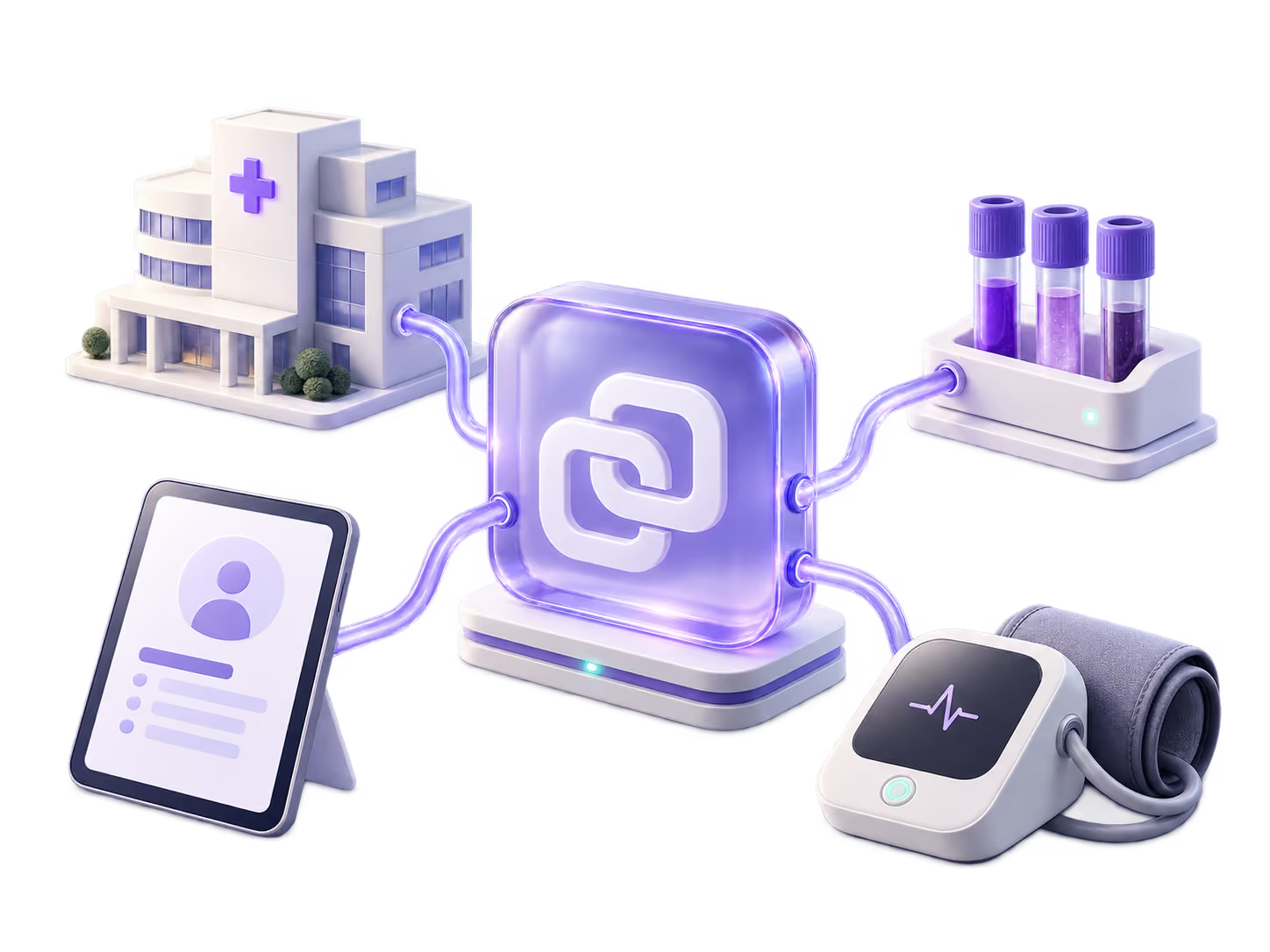
Connect the workflow as well as the interface
Patient administration and identity
Connect ADT events and authorized identity workflows across the systems that use patient and encounter information.
Clinical orders and results
Coordinate the exchange between clinical applications and laboratory, imaging and other departmental services.
Imaging and departmental systems
Connect radiology (RIS), imaging archives (PACS/VNA) and laboratory systems (LIS). Additional interfaces can cover emergency care (EDIS), operating rooms (ORIS), anaesthesia (AIMS) and cardiology (CVIS), according to the agreed integration scope.
Care networks and patient access
Connect external providers, patient portals and remote patient monitoring (RPM) services, including software as a medical device (SaMD) under its own regulatory controls, through approved interfaces, using IEEE 11073 standards where supported by the participating medical devices.
Financial and administrative workflows
Connect agreed billing, procurement, inventory and reporting processes to the wider hospital environment, including GS1 barcode identification and national track-and-trace systems such as TTAC where pharmaceutical traceability applies.
A clear path from interface inventory to operational ownership
Discover
Inventory systems, interfaces, stakeholders, permissions and workflow dependencies.
Design
Agree message contracts, terminology, identity rules, exception paths and acceptance criteria, including any quality measures expressed in Clinical Quality Language (CQL).
Implement
Configure the engine and connectors, build missing interfaces and introduce appropriate orchestration.
Validate
Test conformance, end-to-end workflows, failure handling, duplicate prevention and recovery with system owners.
Migrate and introduce
Rehearse data migration and cutover, reconcile outcomes and roll out in agreed stages.
Operate and improve
Transfer runbooks, monitoring and escalation ownership; review adoption and support findings.
Standards, AI and responsibilities in the delivery
HL7 v2, FHIR, CDA, DICOM and applicable IHE profiles provide the exchange patterns. Terminology and classification requirements are selected for the workflow. AI orchestration can support coordination and exception review through the approved engine and connector layer.
Discovery and engineering
Integration design
Migration planning
Technical testing
Release support
Monitoring and handover within scope
Authorized access
Clinical and terminology decisions
Accountable service owners
Vendor participation
Acceptance testing
Local rollout approval
Integration program designs
Regional Clinical Interoperability Platform
A regional integration platform designed to connect hospital, laboratory and community-care records through shared identity, terminology and exchange services. The program combines legacy interface migration, traceable data flows and phased provider onboarding, with operational monitoring and rehearsed recovery procedures built into the delivery scope.
Cross-Border Care Continuity Platform
A care-continuity platform designed for Danish providers exchanging patient summaries with authorized partners in Sweden. It brings patient-summary assembly, identity checks, terminology reconciliation and provenance into a shared workflow, supported by localized clinical views, partner onboarding and a dedicated environment for testing exchange readiness before each rollout.
Connected Care Device Integration Platform
A device integration platform designed for remote-care services across Vancouver and regional communities in British Columbia. It connects monitoring providers with clinical systems through verified device assignments, validated observations and resilient delivery, with device lifecycle management, low-connectivity recovery and service-wide visibility into missing or delayed data.
These program designs illustrate proposed scope and delivery considerations; timelines and target markets are planning scenarios, not completed projects.
.png)
.png)

