
.avif)
Reliable IT services for the work of a hospital
Support hospital services through IT service management (ITSM), with clear ownership and escalation. The operating model combines incident and change management, standard operating procedures (SOPs), disaster recovery (DR) planning and coordination with network and security operations centres (NOC/SOC), within the agreed service scope.
.avif)
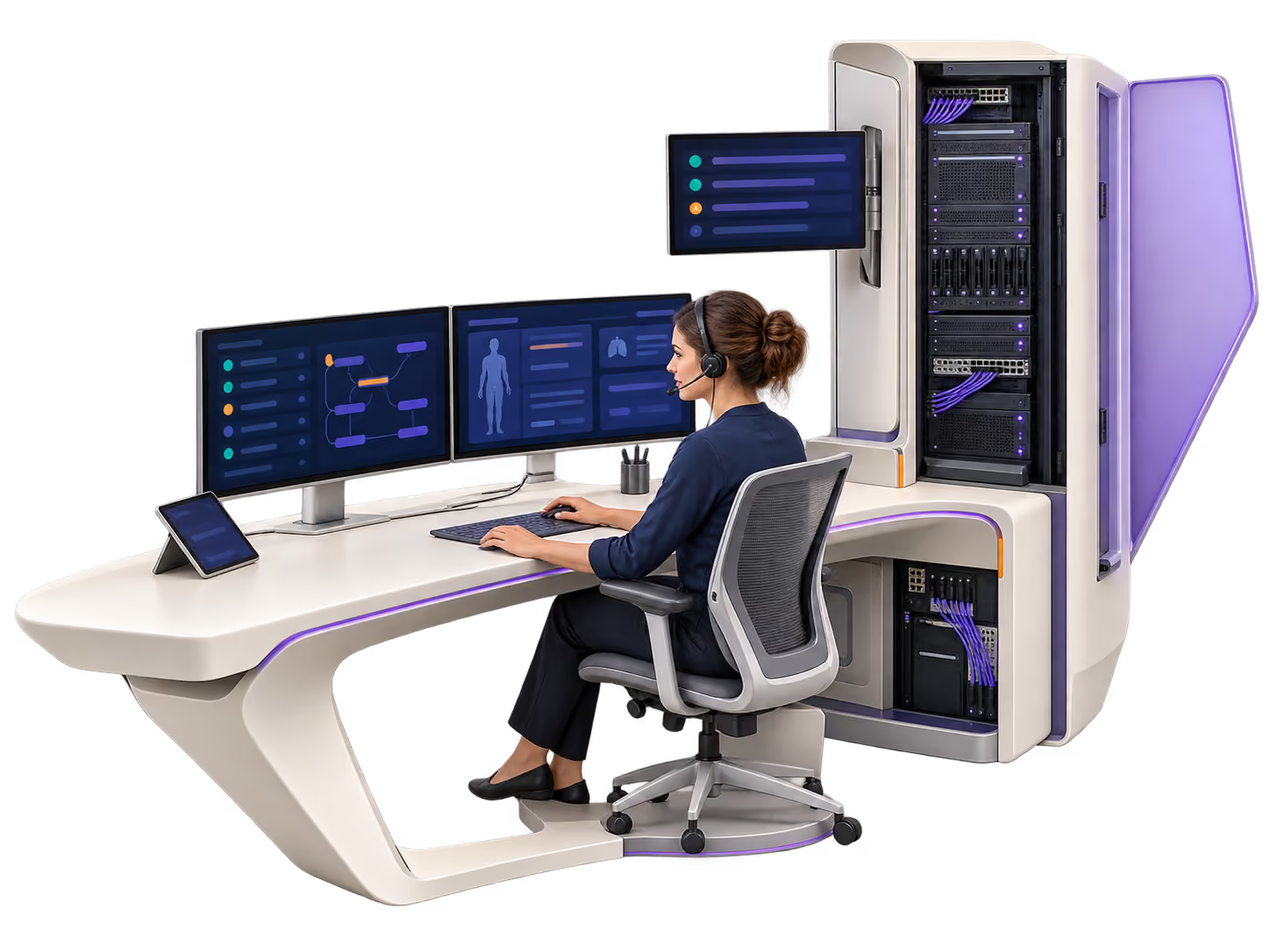
Four support levels, with clear responsibility at every escalation
Our four-level operating model defines how requests and incidents move from frontline support to specialist resolution and external vendors. It is aligned with ITIL practices and tailored to each hospital's service scope.
Service desk and first response
Log and classify incidents and requests; assess service impact; help with authorized account access, workstations and known application issues; follow approved runbooks; communicate status and escalate unresolved incidents.
Application and infrastructure support
Investigate HIS, EMR/EHR and departmental application issues; diagnose approved network, server and database problems; examine interface failures and monitoring alerts; restore services within agreed technical authority.
Specialist engineering and complex resolution
Resolve complex defects in in-scope software and integrations; investigate recurring incidents; plan controlled fixes, releases and recovery improvements; coordinate architecture and engineering expertise.
Vendor and manufacturer escalation
Work with software vendors, cloud providers or device manufacturers on proprietary defects, vendor patches, licensing and issues requiring their authority; prepare evidence and track resolution.
Support levels describe skills and responsibility. They are not clinical triage, incident severity or HIMSS maturity stages. ZeroOne does not own or patch third-party clinical systems; proprietary defects are resolved by the vendor through L4.
An operating model beyond the ticket queue
Incident and major-incident coordination
Restore agreed services, prioritizing hospital impact and maintaining a clear communication channel.
Service requests and knowledge
Handle recurring requests through approved procedures and reusable support knowledge.
Problem management
Investigate repeat failures and maintain workarounds and corrective actions.
Change, release and deployment
Introduce changes with risk review, testing, approvals and recovery planning appropriate to the service, promoted through separate DEV, TEST, TRAIN and PROD environments.
Monitoring and service configuration
Connect service events with the systems, dependencies and responsible teams needed for investigation.
Service levels and continual improvement
Review agreed targets, service performance, user experience (UX) feedback from clinical and administrative staff, and improvement priorities.
Across the model we consider ITIL's four dimensions: organizations and people; information and technology; partners and suppliers; and value streams and processes.
Support organized around care delivery
A laboratory interface interruption, an ADT workflow issue and a finance-system request have different consequences. We map those dependencies with your service owners so support priorities reflect the hospital's operating context.
Patient administration and ADT
Registration, identity, admission, discharge and transfer workflows and the interfaces that carry ADT events.
Clinical systems
EMR/EHR applications, documentation, ordering and medication workflows used by care teams.
Departmental and ancillary systems
Laboratory, imaging, pharmacy and nursing systems, including bedside devices such as workstations on wheels (WOW), and their connections to the wider environment.
Financial and administrative systems
Billing, procurement, inventory, workforce and reporting applications, plus the building management system (BMS) and computerized maintenance management system (CMMS) where facilities and biomedical equipment are in scope.
Define the service before taking responsibility
Before transition, we agree the documents and targets that govern the service. Hours, targets and reporting are set per engagement against your hospital's needs.
Service catalogue
Support hours
Escalation tree
Downtime procedures
Ownership matrix
Access boundaries
Response and restoration targets
Reporting cadence
Transition in four steps
Discover dependencies
Inventory systems, interfaces, vendors and the teams who own each service.
Agree responsibilities
Confirm the service catalogue, ownership matrix and escalation paths with service owners.
Prepare access and runbooks
Set up the access our support team needs through the hospital's IAM and single sign-on (SSO), in line with its Zero Trust policies and network segmentation (VLANs). Prepare runbooks and document who monitors and responds to security events (SIEM), endpoint alerts (EDR), web application firewall (WAF) blocks and data loss prevention (DLP) incidents, referencing NIST and OWASP guidance where the hospital's security policy adopts them.
Transition and review
Take over support in stages and review performance and gaps with the hospital.
Planning new systems or integrations?
.png)
.png)

