

Artificient
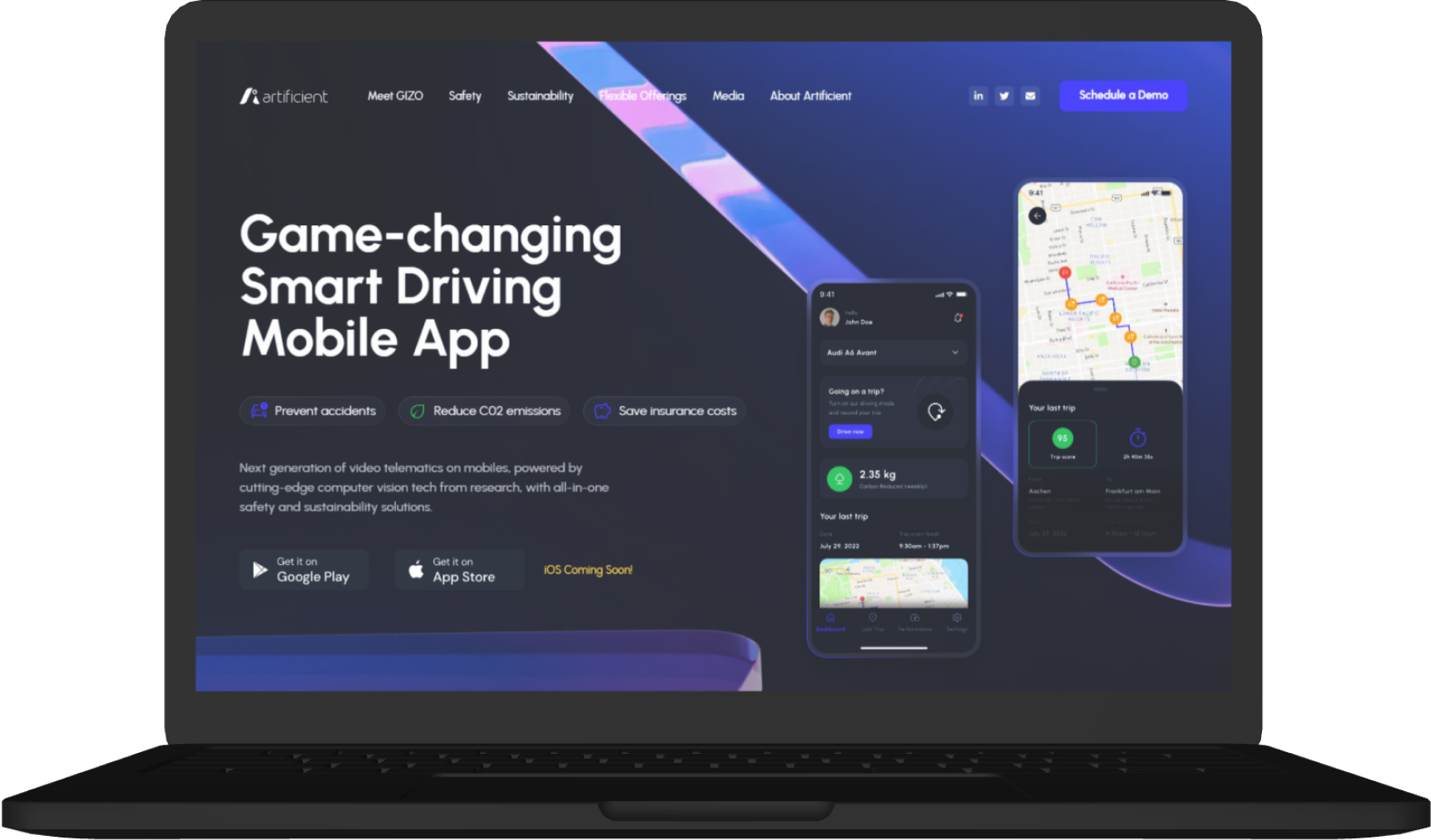
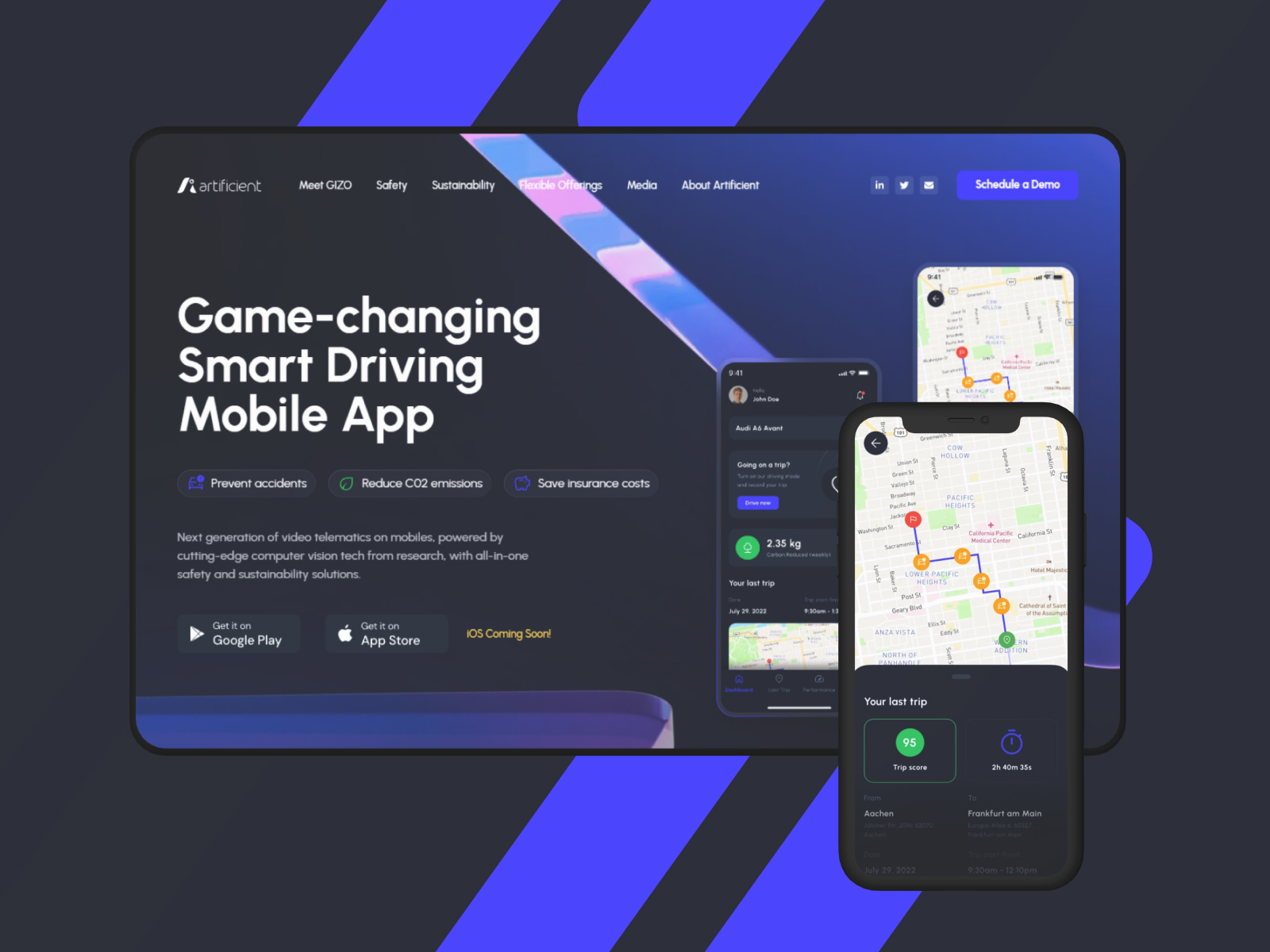
Smart driving app that analyses driving behaviour, risk and CO₂ emissions to power personalised insurance pricing.

The brief behind the build.
Our client approached us to develop a solution addressing the lack of personalized insurance pricing that factors in individual driving habits and environmental considerations. Traditional insurance models rely on generalized risk assessment, often leading to higher premiums for safe drivers or environmentally conscious individuals. The client’s goal was to reward responsible driving behavior and promote eco-friendly practices through accurate data measurement and analysis.
- CO2 Emissions Measurement
- Data Collection
- Data Processing and Analysis
- User Score and Premium Calculation
- Kotlin Mobile Application
- Python Backend
- ASP.NET Core
- Angular
- Kotlin
- Python
- TensorFlow
- Android app A Kotlin app collects driving data reliably in the background.
- Data processing in Python Trips are processed and analysed on a Python backend.
- Risk and CO₂ models TensorFlow models score driving behaviour, predict risk and factor in CO₂ emissions.
- Secure backend and admin An ASP.NET Core backend and an Angular admin panel manage users, policies and premiums.
How we solved it.
Working closely with the client’s team, we designed and implemented a comprehensive solution that leveraged modern technologies to meet their requirements. Our responsibilities included:
- Building the mobile application in Kotlin for reliable, high-performance Android functionality.
- Developing backend data processing and analysis in Python, incorporating TensorFlow for machine learning models.
- Creating and training models to analyze driving patterns, predict risk scores, and factor in CO₂ emissions.
- Implementing the backend infrastructure in ASP.NET Core to manage secure data transmission, authentication, and server-side logic.
- Building an Angular-based admin panel for efficient policy and user management.
What shipped, module by module.
- CO2 Emissions Measurement Measures CO2 emissions generated by the user’s vehicle. Utilizes vehicle onboard diagnostics or external sensors for accurate environmental impact assessment.
- Data Collection Collects user data, including speed, location, acceleration, and other relevant metrics. Utilizes smartphone sensors or optional telematics devices for data collection.
- Data Processing and Analysis Securely transmits collected data to a server for processing. Applies advanced algorithms and machine learning techniques for driving behavior analysis and risk score calculation.
- User Score and Premium Calculation Generates a personalized user score reflecting driving performance and carbon footprint. Uses the user score to calculate insurance premiums, ensuring fair and competitive rates.
- Kotlin Mobile Application Kotlin used as the primary programming language for the mobile application. Provides a modern and expressive language for building high-performance and reliable mobile apps.
- Python Backend Python utilized for backend data processing and analysis tasks. Rich ecosystem of libraries and frameworks for implementing advanced algorithms and machine learning.
- TensorFlow for Machine Learning TensorFlow, an open-source machine learning framework, employed for developing models. Analyzes driving behavior patterns and predicts risk scores with precision.
- ASP.NET Core Backend ASP.NET Core serves as the backend framework for server-side components. Provides a powerful and secure foundation for data transmission, authentication, and server-side functionalities.
- Angular Admin Panel Angular used for developing the admin panel for efficient management. Component-based architecture and extensive tooling support for a responsive and intuitive user interface.
- Personalized Premium Calculation Accurately calculates insurance premiums based on individual driving behavior and environmental impact. Ensures fair rates aligned with policyholders’ risk levels and responsible behavior.
- Improved User Experience Seamless and user-friendly experience through the Kotlin mobile application. Easy access to personalized insurance information, driving scores, and environmental impact tracking.
- Precise Risk Assessment Advanced machine learning models analyze driving behavior patterns with precision. Considers factors such as speed, location, acceleration, and CO2 emissions for accurate risk assessments.
- Promoting Environmental Awareness Measures and analyzes CO2 emissions, promoting eco-friendly driving practices. Raises awareness of the environmental impact and encourages greener driving behaviors.
- Efficient Policy Management Admin panel facilitates efficient tools for policy management, data analysis, and user behavior monitoring. Offers intuitive data visualization, comprehensive reporting, and streamlined policy administration.
The stack behind it.
- Kotlin We employed Kotlin as the primary programming language for developing the mobile application. Kotlin is a modern and expressive language that integrates seamlessly with Android platforms, providing a solid foundation for building high-performance and reliable mobile apps.
- Python Python was utilized for the backend data processing and analysis tasks. Its rich ecosystem of libraries and frameworks, along with its simplicity and readability, made it an ideal choice for implementing advanced algorithms and machine learning techniques.
- TensorFlow TensorFlow, an open-source machine learning framework, played a crucial role in developing models for analyzing driving behavior patterns and predicting risk scores. TensorFlow's flexibility and scalability allowed us to train and deploy complex machine learning models efficiently.
- ASP.NET Core ASP.NET Core served as the backend framework for building the server-side components of our application. It provided a powerful and secure foundation for handling data transmission, authentication, and other server-side functionalities.
- Angular Angular was used for developing the admin panel, which enables efficient management and administration of the application. Angular's component-based architecture and extensive tooling support facilitated the creation of a responsive and intuitive user interface for the admin panel.


