
.avif)

Benefits of Custom Software Development for Growing Businesses
Most growing companies eventually hit the same wall: the software that got them to 20 employees starts breaking down at 50. Spreadsheets multiply, tools stop talking to each other, and teams build workarounds just to get through the day. This is usually when the benefits of custom software development start to look less like a luxury and more like a practical fix. This article breaks down what custom software actually offers, when it makes sense, and how to decide if it is worth the investment for your business right now.
What Is Custom Software Development?
Custom software development is the process of designing and building an application specifically for one organization's workflows, rather than adapting your workflows to fit a product built for thousands of other companies. A development team works directly with your business to map out how you actually operate, then builds tools around that reality.
This is different from SaaS platforms or off-the-shelf software, which are designed to serve a broad market. Those products work well when your processes are fairly standard. Custom software becomes more relevant once your operations, data structure, or customer experience start to diverge from what generic tools assume.
For a closer look at how these approaches differ in practice, see this comparison of ZeroOneTech custom software development services
Top Benefits of Custom Software Development

Growing businesses tend to run into the same handful of pain points as they scale. Here is where purpose-built applications typically make the biggest difference.
Tailored to Your Exact Needs
Off-the-shelf tools are built for the average user, which means most companies end up using maybe 60 percent of the features while working around the gaps for everything else. Custom software is built around your actual process, not a generic one.
That means fewer manual workarounds, fewer spreadsheets duct-taped to your main system, and software that matches how your team already thinks about the work.
Better Scalability

Generic platforms often come with rigid pricing tiers, user caps, or performance limits that were never designed with your specific growth pattern in mind. Custom-built business software can be architected from the start to handle the kind of scale you actually expect, whether that means more users, more transactions, or more complex data.
This does not mean scalability is automatic. It depends on the architecture decisions made early in the project, which is why this planning stage matters more than most teams expect.
Competitive Advantage
When every company in your industry runs the same SaaS stack, none of them are differentiating on process. A tailored software solution built around a genuinely better way of doing something, whether that is faster fulfillment, a smoother client experience, or better internal visibility, is much harder for competitors to copy than a workflow built entirely on shared, publicly available tools.
Seamless Integration With Existing Tools
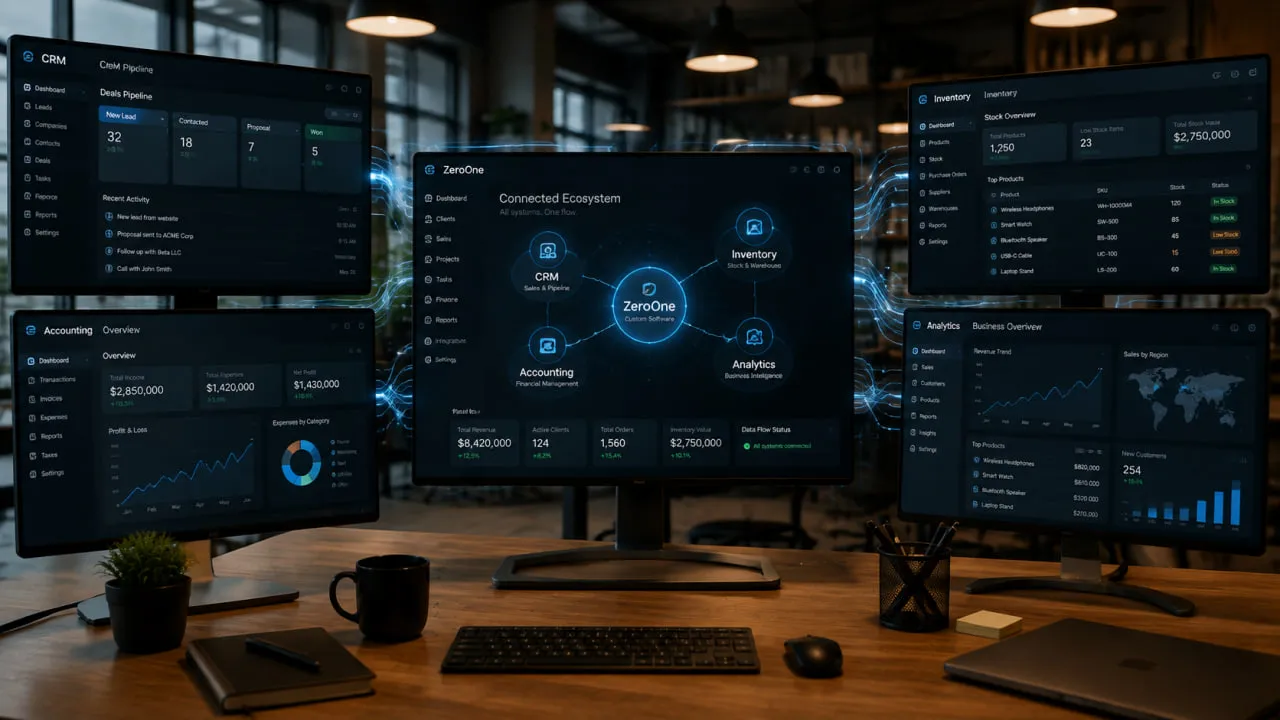
Most growing businesses run on a patchwork of systems: a CRM, an accounting platform, maybe an inventory tool, all connected by manual exports and a lot of copy-pasting. Custom software can be built with integration as a core requirement rather than an afterthought, connecting directly to the systems you already depend on through APIs.
The result is fewer duplicate data entries and fewer reconciliation errors between systems that were never meant to talk to each other.
Long-Term Cost Efficiency
Custom software usually costs more upfront than a SaaS subscription. That part is true and worth being honest about. The long-term math looks different once you factor in per-user licensing fees that scale with headcount, add-on costs for features you actually need, and the productivity lost to workarounds.
Over a multi-year horizon, many growing businesses find that a purpose-built system costs less than stacking multiple subscriptions and paying for seats you are not fully using. This lines up with broader research on technology investment, including McKinsey's analysis of digital transformation, which finds that the return on a technology investment depends heavily on how deliberately it is planned and adopted, not just on the technology itself.
Stronger Security
With off-the-shelf software, your security posture depends heavily on a vendor's infrastructure, update schedule, and shared multi-tenant environment. Custom software gives you direct control over authentication methods, data storage, access permissions, and how sensitive information moves through your systems.
Control is not the same as guaranteed security, though. A custom application is only as secure as its architecture, testing process, and ongoing maintenance. Following established frameworks like the NIST Cybersecurity Framework during development and after launch is one practical way to build security in a structured way rather than bolting it on later.
When to Choose Custom Software Over Off-the-Shelf Software
Custom software is not automatically the right call for every business. Understanding the benefits of custom software development only matters once you know when those benefits actually apply to your situation.
The decision usually comes down to how standard your processes are, how urgently you need something running, and what budget you are working with.
A useful way to think about it: the more your operations resemble a generic template, the less you need something built from scratch. The more your workflows, compliance requirements, or customer experience genuinely differ from what off-the-shelf tools assume, the stronger the case for a tailored build.
For a more detailed breakdown of these trade-offs, this guide to Custom Software vs Off-the-Shelf Software walks through specific scenarios in more depth.
If you are still weighing the decision, these questions tend to clarify things quickly:
- Do your core workflows differ meaningfully from what a standard SaaS tool assumes?
- Will you still be using this process, at a larger scale, in three to five years?
- Are you currently paying for multiple tools that only partially solve the problem?
- Does your industry have compliance or data-handling requirements that off-the-shelf tools handle awkwardly?
- Can your team commit to a multi-month build, or do you need something running this quarter?
Answering these honestly usually points toward one option fairly clearly.
Real-World Examples of Custom Software in Action
These are realistic, hypothetical scenarios based on common patterns across industries, not specific client case studies. Each one shows the benefits of custom software development playing out in a different operational context.
Healthcare: A multi-location clinic group replaces a generic scheduling tool with a custom system that handles provider availability, insurance verification, and patient intake in one place, cutting down on double-bookings and front-desk phone time.
Logistics: A regional freight company builds a custom dispatch and tracking platform that connects directly to its existing fleet-management hardware, something no off-the-shelf tool supported without expensive workarounds.
E-commerce: A mid-sized retailer with a complex product catalog builds a custom inventory system that syncs in real time across its warehouse, storefront, and wholesale channels, avoiding the overselling issues that plagued their previous spreadsheet-based process.
Financial services: A lending firm develops a custom underwriting workflow that applies its specific risk rules automatically, replacing a manual review process that had become a bottleneck as loan volume grew.
Manufacturing: A parts manufacturer builds custom production-tracking software that connects shop-floor equipment to its planning system, giving managers real-time visibility that generic ERP modules could not provide out of the box.
Professional services: A growing consulting firm replaces three disconnected tools, time tracking, invoicing, and project management, with a single custom platform built around how its teams actually structure engagements.
Final Thoughts

Deciding between custom and off-the-shelf software rarely comes down to one being universally better. It comes down to how far your business has grown past what generic tools were designed to handle, and whether that gap is costing you more in workarounds than a tailored build would cost to create. Weighing the benefits of custom software development against your current constraints is ultimately a business decision, not just a technical one.
If your team is duct-taping systems together, hitting scalability limits, or watching competitors move faster because their tools fit their process better, it may be worth a closer look at what a purpose-built solution could do differently. ZeroOneTech works with growing businesses to evaluate exactly this kind of decision, and to design and build when a tailored solution turns out to be the right fit. If your current tools are starting to limit how your team works together or how fast you can scale, it is worth a conversation about what custom software could realistically solve for you.
FAQs
1. Is custom software more secure than off-the-shelf software?
Not automatically. Security depends on how the software is architected, tested, and maintained, not just who built it. Custom software gives you more direct control over access controls and data handling, which can be an advantage if implemented well. Off-the-shelf platforms benefit from vendor-managed updates and dedicated security teams. Neither option is inherently safer without proper implementation, as outlined in resources like the OWASP Top Ten.
2. How long does it take to build custom software?
Timelines vary significantly based on scope, integrations, and complexity. A focused internal tool might take two to three months, while a larger platform with multiple integrations and compliance requirements can take six months to a year or more. Discovery and planning at the start of the project usually determine how accurate the final timeline turns out to be.
3. Is custom software expensive?
The upfront cost is typically higher than a SaaS subscription, since you are paying for design and development rather than a shared product. Whether it is more expensive overall depends on your timeline. The financial benefits of custom software development often show up over a multi-year horizon rather than in the first year, once you factor in avoided subscription costs and reduced manual work.
4. Can custom software be updated later?
Yes. One advantage of owning your own codebase is that you control the update schedule and can add features as your business changes, rather than waiting on a vendor's product roadmap. This does require an ongoing development relationship, either with an internal team or an outside partner, to keep the software current.
5. Who maintains custom software after launch?
This depends on the arrangement you set up with your development partner. Some businesses bring maintenance in-house once the software is stable, while others keep an ongoing contract with the original development team for updates, bug fixes, and new features. It is worth clarifying this before the project starts, since post-launch support is often underestimated during planning.

.png)
.png)

