


7 Ways AI Automation Can Transform Your Daily Business Operations
Most businesses don’t struggle with lack of tools. They struggle with how those tools work together.
Data moves manually between systems. Decisions rely on outdated reports. Teams spend more time coordinating than executing.
At ZeroOne, we approach AI automation as a structural layer that removes this friction. Instead of adding more tools, we focus on connecting workflows so operations run as a unified system rather than a set of disconnected tasks.
Quick Answer:
AI automation transforms daily business operations by replacing manual coordination with system-driven workflows, enabling real-time decision-making, and creating consistent execution across departments. At ZeroOne, this approach allows businesses to move away from managing complexity manually and operate through connected systems that scale without increasing operational friction.
Core Comparison
1. Removing Manual Coordination Between Systems

In most organizations, systems exist in isolation. A CRM manages customer data, a marketing platform handles campaigns, and a support tool tracks tickets. Each system performs its role, but none of them operate as part of a unified process.
This creates a hidden layer of manual coordination.
Each handoff introduces a failure point. A small delay in lead assignment or follow-up timing directly impacts conversion, even when everything else is working correctly.
Teams export, import, update, and reconcile data across tools. Over time, this process introduces delays, inconsistencies, and operational fatigue.
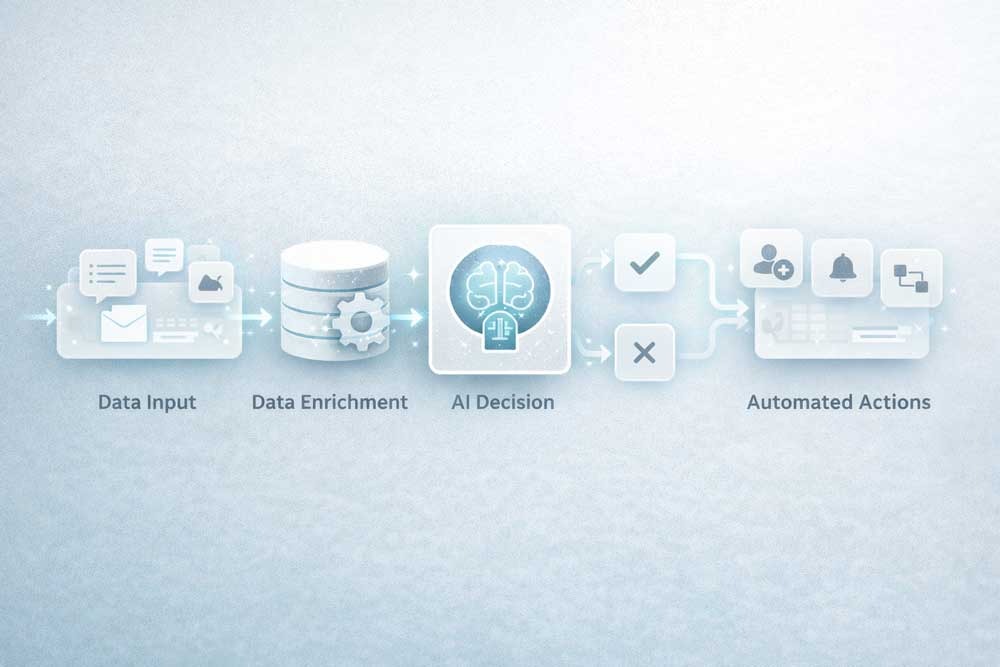
AI automation removes this layer entirely. Instead of moving data manually, workflows connect systems directly. When an event happens in one system, it triggers actions across others without human intervention.
A new lead does not wait to be processed. It is instantly created, enriched, assigned, and placed into the correct stage. A support issue does not remain isolated. It updates customer health metrics and informs account managers in real time.
The result is not only faster execution. It is a unified operational environment where every system reflects the same reality at the same time.
2. Shifting Decision-Making from Reports to Real-Time Signals
Most operational decisions rely on reports. Reports summarize what already happened. By the time they are reviewed, the situation has often changed.
By the time a pattern appears in a report, the underlying behavior has already shifted, which limits the ability to act on it.
This is why tracking outcomes like churn at the end of a cycle rarely improves retention on its own.
This delay affects every part of the business. Sales teams follow up too late. Customer success teams react after churn signals become obvious. Operations teams identify bottlenecks after they impact performance.
AI automation replaces this delayed model with continuous signal monitoring. Instead of waiting for summaries, the system evaluates live data as it flows through the business.
Changes in behavior, engagement patterns, or operational metrics are detected immediately. When predefined conditions are met, actions are triggered without delay.
This shifts decision-making from reactive to proactive. Businesses respond to signals as they emerge, not after they appear in reports.
The impact is subtle at first, but over time it compounds. Faster responses lead to better outcomes, and better outcomes reinforce the system’s effectiveness.
3. Structuring Customer Journeys as Systems
Customer journeys often depend on individuals remembering what to do next. A follow-up email needs to be sent. A demo needs to be scheduled. A customer showing signs of disengagement needs attention.
When these actions depend on memory or manual tracking, inconsistencies appear. Some customers receive timely attention, while others fall through gaps.
AI automation transforms customer journeys into structured systems. Each stage is defined, and transitions are triggered automatically based on behavior.
A new customer enters the system and moves through onboarding without relying on manual coordination. Engagement is tracked continuously. If activity drops, the system triggers intervention at the right moment.
This creates a consistent experience across all customers. It does not depend on team size or individual performance. The process itself ensures reliability.
Over time, this consistency becomes a competitive advantage. Customers experience predictable and responsive interactions, which strengthens trust and retention.
Example scenario:
A mid-sized B2B SaaS company generates leads through its website and runs a typical sales-assisted onboarding process. Before automation, the workflow depends on manual coordination. Leads wait to be reviewed, assignments are delayed, and follow-ups are inconsistent. Some high-intent leads convert, others drop off simply due to timing gaps.
After implementing AI-driven automation, the same process runs as a continuous system. Each new lead is scored instantly, assigned based on predefined logic, and moved into a structured follow-up sequence. Engagement signals determine whether the lead progresses, pauses, or requires intervention.
The difference is not in volume or effort. It is in execution consistency. The business no longer depends on individual actions to maintain flow. The system ensures that every lead moves through the pipeline with the same level of precision.
4. Standardizing Repetitive Operational Tasks
Repetitive tasks are a necessary part of business operations, but they introduce variability when handled manually. Even well-trained teams produce inconsistent results over time due to differences in execution, workload, or interpretation.
Tasks such as invoicing, order processing, data validation, and reporting are especially prone to these inconsistencies. Small errors accumulate and affect downstream processes.
AI automation standardizes these tasks by defining clear execution rules. The system performs the same action in the same way every time.
This removes variability from routine operations. Data becomes more reliable. Processes become more predictable.
The value of this standardization extends beyond efficiency. It creates a stable operational foundation where other improvements can be built. Without consistency at this level, scaling becomes difficult.
5. Reallocating Human Effort to High-Impact Work
In many businesses, skilled employees spend a significant portion of their time on low-value tasks. Updating records, organizing data, and maintaining systems consume hours that could be used for more impactful work.
This misallocation of effort limits overall performance. Teams appear busy, but much of their activity does not directly contribute to growth.
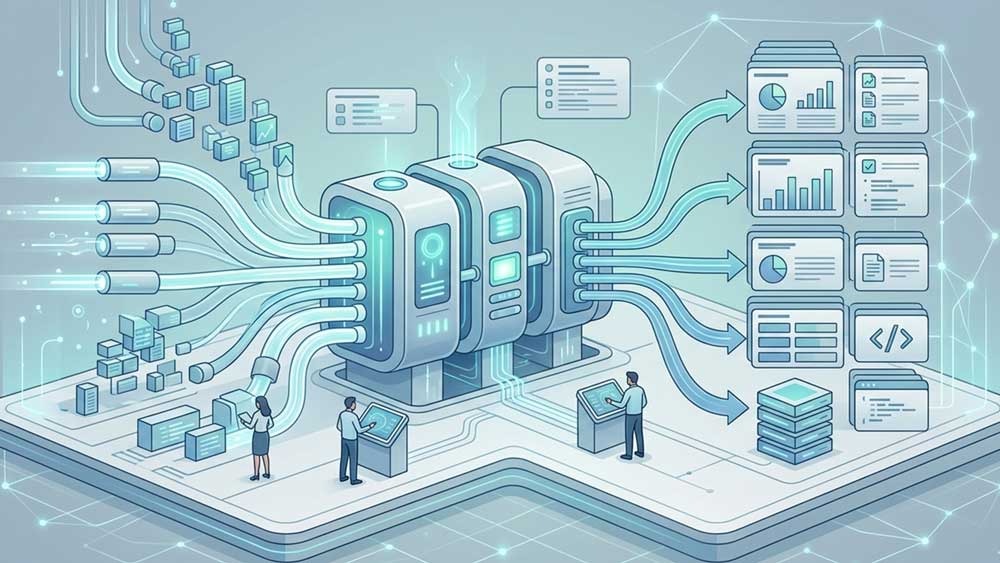
AI automation changes this dynamic. By taking over repetitive and administrative tasks, it frees up human capacity for higher-value activities.
Sales teams focus on building relationships and closing deals. Customer success teams concentrate on solving complex problems. Leadership spends more time on strategy and less on operational oversight.
This shift improves both productivity and quality. When teams are not overloaded with routine work, they make better decisions and deliver better outcomes.
6. Creating a Unified Layer of Operational Visibility
Businesses often have access to large amounts of data but struggle to gain clarity from it. Different systems produce different metrics, and aligning them requires significant effort.
This fragmented visibility makes it difficult to understand what is happening in real time. Decision-makers rely on partial information and delayed insights.
AI automation creates a unified visibility layer by connecting data across systems. Instead of isolated reports, businesses gain a continuous view of operations.
Key metrics such as pipeline status, customer health, support workload, and operational performance are available in a single context.
This allows leaders to identify issues early, allocate resources more effectively, and make informed decisions based on current data.
Visibility becomes an active tool rather than a passive report.
7. Scaling Operations Without Increasing Complexity
Growth introduces complexity when processes depend on manual coordination. More customers require more handling, and more handling increases the need for communication and oversight.
What works at ten inputs per day often breaks at one hundred, not because demand increases, but because coordination does not scale at the same rate.
Without automation, scaling operations often means adding more people to manage this complexity. This approach increases costs and introduces new coordination challenges.
AI automation changes the scaling model. Workflows operate independently of team size. As demand increases, the system continues to execute processes without requiring proportional increases in human effort.
Lead routing remains efficient regardless of volume. Customer journeys continue to function as designed. Reporting scales with data without becoming harder to manage.
Automation changes this by separating execution from team capacity, allowing the same system to handle increasing volume without additional coordination layers.
This allows businesses to grow while maintaining operational stability. Complexity does not increase at the same rate as demand.
Where AI Automation Fails

Despite its potential, AI automation does not always deliver results. The most common reason is not technology failure, but structural issues within the business.
Automation applied to unclear processes creates confusion. If workflows are not well-defined, the system cannot execute them reliably.
Similarly, fragmented data reduces the effectiveness of automation. When systems operate on inconsistent information, automated actions may produce incorrect outcomes.
Successful implementation requires a clear operational structure. Processes need to be defined, data needs to be aligned, and systems need to be connected.
AI automation amplifies what already exists. If the foundation is strong, it enhances performance. If the foundation is weak, it exposes and accelerates problems.
Implementation Model
Final Perspective
AI automation is not a feature that improves isolated parts of a business. It is a structural layer that determines how operations function as a whole.
When implemented correctly, it removes friction, improves consistency, and enables scalable growth. Daily operations become more predictable, and decision-making becomes more responsive.
Businesses that rely on manual coordination eventually reach a limit where complexity slows them down. Those that adopt system-driven operations move beyond that limit.
The difference is not incremental. It is structural, and over time, it becomes decisive.
Stop managing tools. Start building systems.
Automation isn’t about adding features; it’s about removing friction. If your daily operations still rely on manual coordination and "report-based" decisions, your growth has a ceiling. Let’s audit your current workflows and identify where AI can create a unified operational layer.
FAQ
What business processes should be automated first with AI?
The best starting point is not the most advanced process, but the most repetitive and error-prone one. In most businesses, this includes lead handling, internal data synchronization, and customer follow-ups. These processes directly impact revenue and usually suffer from delays and inconsistencies. Automating them first creates immediate operational stability and reveals where deeper automation is needed.
Why do most AI automation projects fail after implementation?
Most failures happen because businesses try to automate tools instead of workflows. When processes are unclear or constantly changing, automation introduces more confusion rather than efficiency. Another common issue is fragmented data, where different systems hold conflicting information. Without process clarity and data alignment, automation amplifies existing problems instead of solving them.
How do you know if your business is ready for AI automation?
A business is ready when it starts experiencing coordination friction. This includes delays between teams, repeated manual data entry, inconsistent customer handling, or difficulty tracking real-time performance. These are not scaling problems, they are structural signals that automation is needed. If daily operations rely heavily on manual follow-ups and internal communication, the system is already under strain.
What is the difference between automation and AI automation in operations?
Automation follows predefined rules and executes tasks consistently. AI automation goes further by reacting to data signals and adapting workflows dynamically. For example, a standard automation might send a follow-up email after a fixed delay, while AI automation adjusts timing and messaging based on customer behavior. The difference is not in execution speed, but in decision quality.
How does AI automation impact operational costs over time?
In the short term, implementation introduces setup costs and process restructuring. Over time, operational costs decrease because fewer resources are required for coordination and error correction. More importantly, hidden costs such as missed opportunities, delayed responses, and inconsistent execution are reduced. The long-term impact is not only cost reduction, but more efficient revenue generation.
Can AI automation replace the need for middle management?
AI automation reduces the need for coordination-heavy roles, but it does not eliminate the need for leadership. Managers shift from overseeing tasks to designing and optimizing systems. Instead of tracking whether work is done, they focus on improving how work flows through the organization. The role evolves from supervision to system-level decision-making.


