


How AI-Driven CRM Predicts Customer Churn Before Customers Leave
Customer churn does not start when a contract ends.
It starts much earlier. It starts when engagement weakens, when usage becomes inconsistent, when internal champions lose interest, or when small frustrations begin to accumulate. By the time churn becomes visible in revenue reports, the underlying signals have already existed for weeks or months.
Most teams are not missing data. They are missing interpretation.
Traditional CRM systems capture customer activity. They log interactions, store account history, and track deals. But they do not explain which customers are at risk or why those risks are forming. This creates a blind spot between data collection and decision making.
AI-driven CRM fills that gap.
Instead of showing only what has happened, it identifies patterns that indicate what is likely to happen next. It highlights customers whose behavior resembles past churn cases and brings those accounts into focus before the loss becomes irreversible.
At ZeroOne, this shift is where CRM becomes operational rather than administrative. It moves from record keeping into active revenue protection.
Short Answer
AI-driven CRM predicts customer churn by analyzing behavioral patterns across usage, engagement, support activity, and transaction history. It assigns risk scores to accounts, identifies early warning signals, and helps teams intervene before customers leave.
Why Traditional CRM Fails to Predict Churn
Most CRM platforms were not designed to predict outcomes. They were designed to document activity.
This distinction matters.
A standard CRM answers questions like: when was the last interaction, who owns the account, what deals are active, and what communication has taken place. These are operational records. They are useful, but they do not reveal trajectory.
Churn is not a single event. It is a gradual shift in behavior. When data is viewed in isolation, these shifts appear normal. A slightly lower login rate, a delayed response, a missed meeting. None of these signals are strong enough on their own.
The problem is cumulative.
When multiple weak signals appear together, they form a pattern. Humans struggle to consistently detect these patterns across large account portfolios. The larger the customer base, the harder it becomes to connect small behavioral changes into a meaningful risk signal.
This is where most churn goes unnoticed until it is too late.
AI-driven CRM addresses this limitation by evaluating behavior as a system rather than as separate events. It looks at combinations of signals over time and compares them against historical churn outcomes. This allows it to identify risk earlier, even when individual indicators appear insignificant.
What AI-Driven CRM Is Actually Doing

AI-driven CRM does not rely on a single indicator. It builds a model of customer behavior using multiple data streams and continuously updates that model as new data arrives.
At a basic level, the system learns from two sources.
First, it analyzes historical customers who have already churned. It identifies patterns that appeared before those customers left. These patterns may include declining usage, increased support friction, or reduced stakeholder engagement.
Second, it evaluates current customers against those patterns. When a current account begins to resemble past churn behavior, the system increases its risk score.
This process is continuous. As more data is collected, predictions become more refined.
The key advantage is consistency. Human teams may notice obvious problems, but they rarely track subtle behavioral shifts across hundreds of accounts with the same level of accuracy. AI systems apply the same evaluation logic to every account at all times.
The Core Data Behind Churn Prediction
Accurate churn prediction depends on the quality and diversity of data available inside the CRM. Systems that rely on a single data source tend to produce weak predictions. Systems that combine multiple data streams produce stronger results.
The most effective AI-driven CRM implementations typically combine four primary data layers.
Usage Data
Usage data reflects whether customers are actively receiving value from a product or service.
A consistent decline in usage is often one of the earliest indicators of churn risk. This may appear as reduced login frequency, lower feature interaction, or shorter session duration. In non-SaaS environments, the equivalent might be reduced engagement with deliverables, fewer service interactions, or lower participation in ongoing activities.
The important factor is not a single drop. It is the trend over time.
Support and Experience Data
Customer experience often drives churn more than product capability.
Repeated support issues, unresolved tickets, or slow response times create friction that accumulates over time. AI models track both the volume and the pattern of support interactions. A single complaint is not critical, but repeated issues around the same problem significantly increase risk.
When support data is integrated into CRM, it provides context that is often missing from sales or account management views.
Engagement and Communication Data
Changes in communication behavior often signal internal disengagement.
Accounts that previously responded quickly may begin to delay responses. Key stakeholders may stop attending meetings. Decision-makers may become less visible. These signals indicate weakening alignment between the customer and the provider.
AI-driven CRM tracks these changes as part of the overall churn model, not as isolated communication metrics.
Commercial and Transactional Data
Financial behavior often reflects shifting priorities.
Customers approaching churn may reduce order frequency, downgrade plans, or delay renewals. These changes do not always indicate immediate loss, but they often represent early-stage churn behavior.
When combined with usage and engagement signals, transactional data strengthens prediction accuracy.
How Churn Scoring Works in Practice
Once these data streams are integrated, the CRM assigns a churn risk score to each account.
This score is not arbitrary. It is calculated based on how closely a customer’s current behavior matches patterns associated with past churn cases. Each signal contributes differently depending on its predictive strength.
The value for teams is prioritization. Instead of reviewing all accounts equally, they can focus on accounts where intervention is most likely to prevent churn.
Where Most AI-Driven CRM Implementations Fail
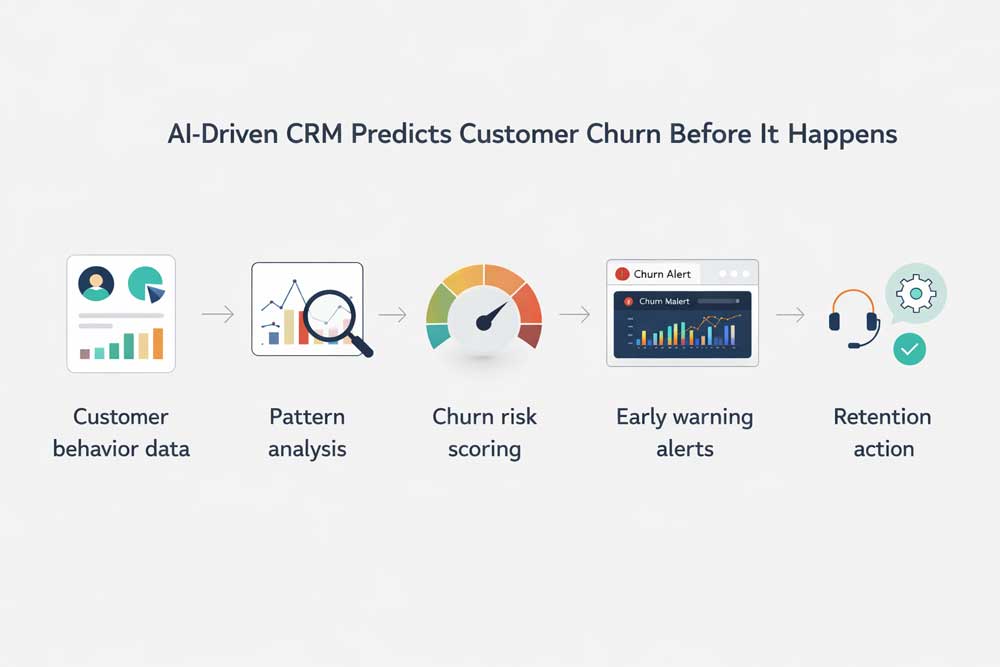
Not all AI-driven CRM systems deliver meaningful churn prediction. Many organizations implement the technology but fail to achieve reliable outcomes.
The issue is rarely the algorithm. It is usually the data environment and operational integration.
Three common failure points explain most weak implementations.
First, fragmented data. When usage, support, and sales data exist in separate systems, the model lacks a complete view of the customer. This reduces prediction accuracy.
Second, low data quality. Inconsistent data entry, missing fields, or outdated records lead to unreliable signals. AI models depend on structured and consistent input.
Third, lack of actionability. Even when churn risk is identified, teams often lack defined workflows to respond. Prediction without intervention does not reduce churn.
AI-driven CRM only creates value when prediction and action are connected.
Turning Prediction Into Retention Action
Identifying churn risk is only useful if the business knows what to do next.
This is where many CRM strategies fall apart. Teams invest in better dashboards, cleaner reporting, and more advanced scoring models, but they still treat retention as a manual and inconsistent process. A risk score appears, someone notices it, and then the response depends on whoever happens to be managing the account.
That is not a retention system. That is reactive account handling.
AI-driven CRM becomes valuable when churn prediction is connected to automated workflows and structured action.
The system should not only identify who is at risk. It should also help determine what kind of intervention makes sense based on the customer’s behavior, account type, contract value, lifecycle stage, and business context.
A high-risk enterprise account with falling stakeholder engagement should not receive the same response as a lower-value account showing weak onboarding adoption. Both matter, but they require different plays.
This is where CRM maturity becomes visible. Mature teams do not simply ask, “Which customers might leave?” They ask, “Which action is most likely to reduce churn for this specific account?”
What Good Intervention Workflows Look Like
Once churn prediction becomes part of CRM, the next step is operational design.
The strongest retention workflows are usually built around a small number of intervention categories rather than endless custom reactions. This keeps the system usable and scalable.
For example, if the CRM detects a decline in usage, the response might involve a product adoption review, training session, or success check-in. If the issue appears to be support-related, the intervention might involve escalation, issue resolution follow-up, or leadership visibility. If the signal is commercial, the response might focus on renewal positioning, account value clarification, or stakeholder re-engagement.
The point is not automation for its own sake. The point is response consistency.
Without defined intervention logic, even accurate churn predictions create little business value.
This is where AI-driven CRM starts affecting retention performance in measurable ways. It reduces delay between signal detection and business response.
Reactive Retention vs Predictive Retention
Most organizations still operate with a reactive retention model.
They respond after the customer complains, after the renewal becomes uncertain, or after the account already begins to contract. By that point, the relationship is often in recovery mode rather than growth mode.
Predictive retention works differently.
Instead of waiting for visible churn symptoms, teams act while the relationship is still recoverable. This creates a major strategic advantage because earlier intervention usually means lower recovery cost and better success rates.
A customer who is mildly disengaged is easier to retain than a customer who has already mentally exited the relationship.
This difference is especially important in B2B environments where churn is rarely impulsive. Accounts usually move through a gradual sequence of weakening commitment. Internal champions lose urgency. Adoption drops. Stakeholder confidence fades. Procurement slows. Leadership stops participating.
If teams wait for certainty, they usually act too late.
AI-driven CRM helps reduce this delay by making weak signals operationally visible before they become financially visible.
Why Churn Prediction Should Not Belong Only to Customer Success
One of the most common mistakes companies make is treating churn prediction as a customer success feature instead of a business system capability.
Churn is not caused by one department. It usually reflects failure across multiple functions.
A customer might churn because onboarding was weak, support quality dropped, product fit declined, internal stakeholders changed, pricing no longer aligned, or value was never made clear. In many cases, the churn outcome is the result of several small breakdowns across the customer lifecycle.
This is why AI-driven CRM works best when it becomes a shared operational layer across teams.
Sales needs visibility into account risk because poor-fit acquisition often creates future churn. Customer success needs visibility because adoption and relationship management sit close to the retention outcome. Support needs visibility because friction patterns are often early warning signs. Leadership needs visibility because churn is a revenue issue, not a service issue.
When churn prediction lives inside CRM rather than inside isolated spreadsheets or separate team tools, the business gains a common customer health model.
That alignment is often more valuable than the score itself.
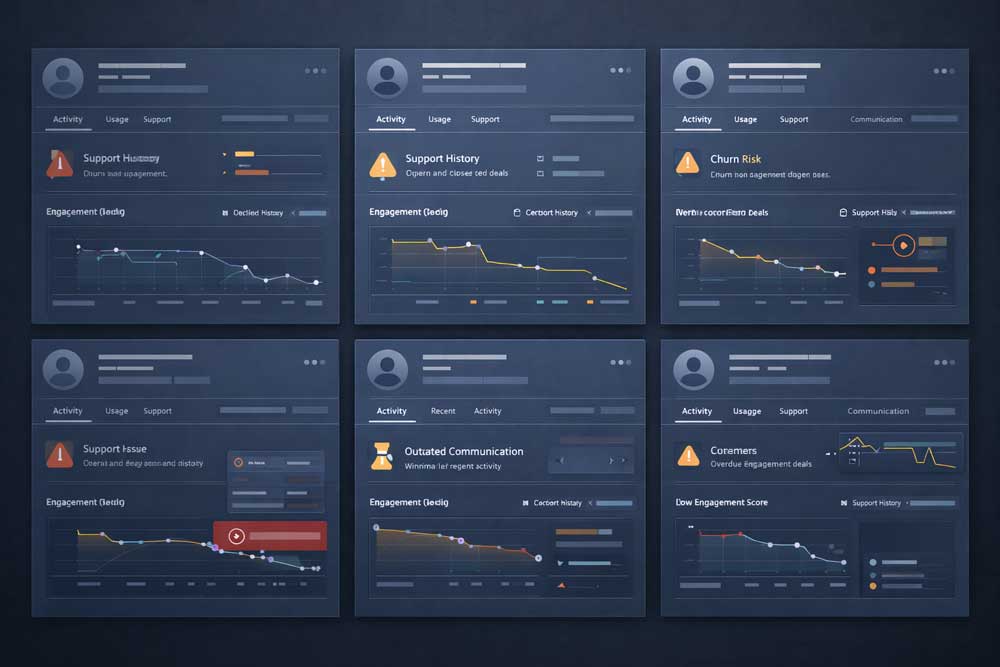
The Role of Segmentation in Better Churn Prediction
Not every customer churns for the same reason.
This is where many AI-driven CRM implementations become too generic. They produce one churn score for the whole customer base without considering customer type, account maturity, product tier, or buying behavior.
That usually leads to weak interpretation.
A small self-serve account and a multi-stakeholder enterprise account do not behave the same way. A new customer in onboarding should not be evaluated using the same retention logic as a mature account in year three. A high-frequency buyer and a seasonal buyer should not trigger the same risk assumptions.
Good churn prediction improves when CRM models are segmented.
That segmentation might be based on:
- customer size
- lifecycle stage
- product or service tier
- industry or account type
- contract structure
- buying frequency
This does not mean the system needs to become overly complex. It means the business should avoid pretending all customers behave identically.
The more churn logic reflects real customer behavior, the more useful the predictions become.
What Businesses Should Measure After Implementing It
A lot of teams evaluate AI-driven CRM the wrong way.
They focus too heavily on whether the model “got it right” in a narrow technical sense, while ignoring whether it improved retention operations in practice.
A stronger evaluation approach looks at business outcomes.
The most useful post-implementation metrics usually include:
- reduction in preventable churn
- improvement in renewal recovery rate
- faster response to at-risk accounts
- better prioritization across account teams
- increased retention within key customer segments
The goal is not to build a perfect prediction engine. The goal is to improve how the organization identifies and responds to retention risk.
That is an important distinction.
Even an imperfect model can create major value if it helps teams focus earlier and act more intelligently.

Why This Matters More as Customer Bases Grow
Smaller companies sometimes assume they do not need predictive churn systems because they “know their customers well.”
That works up to a point.
But once customer portfolios grow, account complexity increases, and data volume expands, informal customer awareness becomes unreliable. Teams begin to depend on memory, intuition, and isolated observations instead of structured visibility.
That is when churn risk becomes harder to detect consistently.
AI-driven CRM becomes more valuable as scale increases because it creates pattern recognition where human oversight starts to break down. It allows teams to retain visibility across more accounts without depending entirely on individual account managers noticing weak signals manually.
This matters even more in businesses with:
- subscription revenue
- repeat purchasing behavior
- long sales cycles
- multi-contact accounts
- layered service delivery
- customer success or account management teams
In these environments, churn is rarely random. It usually leaves clues first. The problem is not whether clues exist. The problem is whether the organization is equipped to recognize them early enough.
Final Thoughts
AI-driven CRM does not eliminate churn.
What it does is reduce how often churn arrives as a surprise.
That alone has major business value.
When CRM evolves from static record-keeping into behavioral prediction, retention becomes more strategic, more measurable, and less dependent on guesswork. Teams stop treating customer loss as something that “suddenly happened” and start seeing it as a pattern that could have been identified earlier.
That shift changes how organizations operate.
It improves prioritization. It sharpens customer health visibility. It helps teams intervene sooner and with more relevance. Most importantly, it turns retention from a reactive function into a structured business capability.
For companies trying to build more intelligent CRM systems, this is one of the clearest use cases for AI with real operational value.
If your business is trying to make CRM more predictive, connected, and useful across the customer lifecycle, ZeroOne helps teams design systems that support better visibility, better decisions, and better retention outcomes.
FAQ
Can AI-driven CRM predict churn with complete accuracy?
No. Churn prediction is based on probability, not certainty. The purpose is to identify elevated risk early enough for teams to respond more effectively.
What kind of businesses benefit most from churn prediction?
Businesses with subscription models, recurring revenue, repeat purchasing behavior, or account-based customer relationships usually gain the most value from churn prediction inside CRM.
Does churn prediction only work for SaaS companies?
No. SaaS companies often use it heavily because they have strong usage data, but the same logic applies to service businesses, B2B companies, membership models, and repeat-purchase environments.
What data is most important for churn prediction?
The strongest models usually combine usage data, support activity, engagement behavior, and transactional history. A broader data view usually improves prediction quality.
Is AI-driven CRM useful without automation?
Yes, but it becomes much more effective when prediction is tied to workflows. Identifying risk is useful. Connecting that risk to clear action is what creates business value.


