
.avif)
Building High-Quality Backlinks: Ethical Tactics That Work
Most teams do not have a backlink problem.
They have a language problem.
They publish content that sounds correct, but does not say anything worth referencing.
It explains, but it does not position. It repeats, but it does not add.
In search, language is not just about clarity. It defines whether your page becomes a source or stays invisible.
At ZeroOne, we do not treat backlinks as something you build after content. We treat them as something your content either earns or fails to earn. And that outcome is decided long before any outreach begins.
Quick Answer:
High-quality backlinks are not created through outreach tactics alone. They are earned when your content communicates something that other sites find worth citing. In ZeroOne’s approach, backlink growth starts with language that introduces clear positioning, structured insight, and information gain. Without that, even technically strong content struggles to attract links or justify indexing.
The Real Barrier Is Not Links, It Is Reference Value
Most backlink strategies fail because they start too late.
They focus on outreach, placement, or volume. But they ignore the core question that determines whether any link should exist in the first place:
Why would another site reference this page?
If the answer is unclear, no tactic will compensate for it. You can push distribution, send emails, or submit your page across platforms, but the result stays weak. Links, if they appear, do not carry weight. In many cases, they do not appear at all.
Reference value is what separates pages that accumulate authority from those that stay static. It is not about how much you write. It is about whether your page introduces something that changes how the topic is understood.
Pages with reference value do one of three things. They define a structure that others reuse. They introduce a perspective that reframes the topic. Or they provide data that supports decisions. Without at least one of these, a page remains replaceable.
This is where most content fails. It stays within safe language. It explains what is already known. It avoids taking a position. As a result, it gives no reason for another site to link to it.
Why Most Backlink Efforts Produce Weak Signals

When reference value is missing, backlink efforts shift toward shortcuts.
Teams start looking for places where links can be inserted instead of earned. This is where low-quality patterns begin to appear. The focus moves toward directories, generic guest posts, or paid placements that exist only to carry a link.
These approaches create activity, but not authority.
Search engines no longer evaluate links as isolated signals. They evaluate the context in which those links exist. A link that sits inside low-value content, or appears disconnected from the topic, carries little weight. In many cases, it is ignored entirely.
More importantly, these patterns fail to build a stable system. Even if short-term movement appears, it does not hold. Rankings fluctuate because the underlying signals are inconsistent.
We do not treat these as mistakes in execution. We treat them as a consequence of starting from the wrong layer. When content does not justify references, link building becomes forced. And forced links rarely perform.
What Defines a Link Worth Having
A high-quality backlink is not defined by a single metric.
It is defined by alignment.
When a link works, it does so because multiple elements are aligned at the same time. When even one of these elements is missing, the link loses most of its value.
Core Elements of a High-Quality Backlink
When these elements are present, the link becomes part of a meaningful structure. It helps search engines understand how your page fits within a topic. It strengthens relationships between concepts and improves how authority flows across pages.
When these elements are missing, the link still exists, but its role changes. It becomes noise. It does not contribute to ranking in a measurable way.
Where Most Backlink Strategies Go Wrong
- Links are evaluated based on domain metrics alone
- Placement inside the content is ignored
- Relevance between topics is weak or nonexistent
- The link is added without a clear reason
These patterns create activity, but not impact.
The distinction matters.
A smaller number of well-aligned links often produces stronger results than a larger number of disconnected ones.
Language as the Starting Point of Link Acquisition
The ability to earn backlinks begins at the sentence level.
If your language is generic, your page becomes interchangeable. If it is interchangeable, it is not referenced. This is the chain that most teams overlook.
Strong pages communicate with intent. They do not try to cover everything. They define what the reader should understand and what decision should follow. This clarity makes the page usable. Usable pages are referenced.
This is why structure alone is not enough. You can organize content well, include headings, and maintain readability, but still fail to attract links if the underlying language does not carry direction.
In practice, this means moving away from neutral explanations and toward positioned insights. Instead of describing what backlink strategies exist, the page must define which ones matter, under what conditions, and why.
That shift changes how the page is perceived. It moves from being a passive resource to an active reference point.
The Role of Content Structure in Linkability
Structure determines whether your content can be used by others.
Pages that attract backlinks are rarely flat. They follow a progression. They begin with a clear answer, expand into context, and then move toward application. This layered structure allows other creators to reference specific parts of the page depending on their needs.
For example, a well-defined framework inside your content can be cited independently. A table that simplifies a complex decision can be embedded or referenced. A clearly articulated process can be linked as a supporting resource.
Without this structure, even strong ideas become difficult to reuse. And if they cannot be reused, they are less likely to be linked.
This is why linkable content is not just about writing quality. It is about designing content in a way that integrates into the broader ecosystem of information.
Where Most Content Falls Short
Most pages fail at a specific point.
They deliver information, but they do not create dependency.
A page that creates dependency becomes something others rely on. It is referenced because removing it would weaken the content around it. This is the level where backlinks begin to accumulate naturally.
Reaching this level requires precision. The page must define something clearly enough that others choose not to replicate it. Instead, they link to it.
Without that clarity, replication is easier than reference. And when replication is easier, backlinks do not form.
Turning Backlink Strategy Into a System
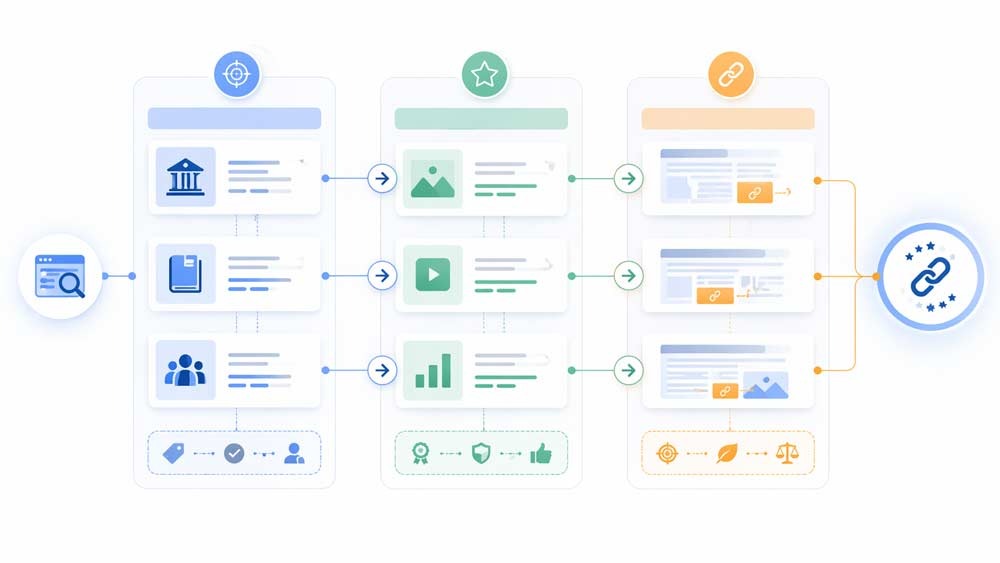
infographic showing backlink quality based on relevance context and natural placement
Backlinks do not scale through isolated actions, but they scale when the system behind content is consistent.
Most teams treat link building as a campaign. They publish content, then try to promote it. When results do not appear, they move on to the next piece. This creates fragmentation. Nothing compounds.
In practice, backlinks follow structure. Pages that sit inside a connected system attract more references because they are easier to trust, easier to navigate, and easier to reuse.
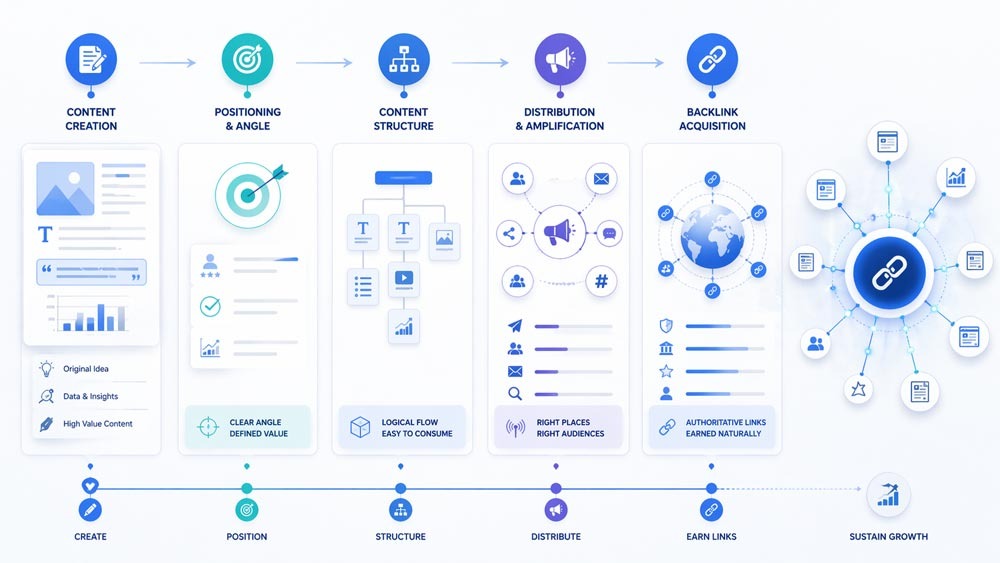
At ZeroOne, we design backlink acquisition as a layered process. Each layer supports the next. Content creates reference value. structure makes that value usable. distribution exposes it. relationships reinforce it.
Without this sequence, efforts remain disconnected.
The Backlink System in Practice
Each layer removes a bottleneck.
If one is missing, growth slows down.
For example, strong content without distribution stays unseen.
Distribution without structure leads to weak retention.
Relationships without content quality produce low-value links.
This is why backlink growth is not linear. It depends on alignment across layers.
Where Ethical Link Building Becomes Practical
Ethical backlink building is often misunderstood as a limitation.
In reality, it is a constraint that forces better systems.
When shortcuts are removed, only one path remains.
You must create something worth referencing, and place it where it can be found.
This does not make the process slower. It makes it more predictable.
The focus shifts from chasing links to enabling them.
There are two key points where this shift becomes visible.
First, outreach changes. Instead of asking for links, you present something that fits naturally into another page.
Second, results become consistent. Instead of spikes followed by drops, you see gradual accumulation.
To make this practical, you need to recognize which actions create signal and which ones create noise.
Actions that strengthen backlink signals:
- Publishing content with a defined role inside a topic cluster
- Linking internally in a way that reinforces context
- Sharing content where the audience already exists
- Referencing and engaging with related creators before outreach
Actions that weaken backlink signals:
- Creating standalone pages with no structural support
- Sending generic outreach without context
- Placing links inside low-value or unrelated content
- Measuring success purely by link count
The difference is not effort. It is direction.
Measuring What Actually Impacts Rankings
Backlink strategies fail when they track the wrong metrics. Counting links is easy. Understanding their impact is not. The goal is not to increase numbers. It is to strengthen signals that influence how search engines interpret your site.
These signals work together.
A single strong link can shift perception.
A pattern of weak links can dilute it.
This is why evaluation must move beyond surface metrics.
From Static Content to Linkable Asset: A Practical Case

To understand how backlink growth actually happens, consider a common scenario.
A company publishes an article about SEO recovery. The page is structured well, technically sound, and covers the topic clearly. Nothing is technically wrong. But nothing stands out.
As a result, the page does not attract links. In some cases, it does not even get indexed.
This is not a technical issue. It is a positioning issue.
We see this pattern often: the content explains the topic, but it does not define anything. It repeats what already exists. From a checklist perspective, it is complete. From a reference perspective, it is replaceable.
The fix does not start with outreach; it starts with restructuring.
We introduce a clear model that breaks the topic into defined layers. Each layer has a role and an outcome. This shifts the page from explanation to structure.
Then we add a comparison element that others can reuse. This makes the page easier to reference.
Internal links are aligned to support the topic, not just navigation.
Distribution is focused on relevant environments, not broad exposure.
The results follow a pattern.
The page gets re-crawled. It gets indexed.
Then references start to appear.
Not because of outreach.
Because the page became usable.
That is the shift.
Content that explains a topic gets ignored.
Content that defines it gets used.
Backlinks follow the second.
Why Some Pages Continue to Attract Links Over Time
Backlink growth is not only about initial visibility.
It depends on whether a page remains relevant as the topic evolves.
Pages that continue to attract links usually share a pattern.
They are not tied to a single moment.
They define something that stays useful.
This often comes down to how the content is positioned.
Pages that focus only on describing tools or tactics tend to fade.
Pages that define structure, frameworks, or decision paths remain relevant longer.
They are referenced repeatedly because they solve a recurring need.
To maintain this effect, updates must follow the same logic.
You do not rewrite the page. You refine it.
You adjust examples. You improve clarity. You expand sections that become more important.
The core structure remains stable.
That stability reinforces trust.
Final Insight
Backlinks are not a separate layer of SEO.
They are a reflection of how your content fits into a larger ecosystem.
When your pages introduce clear structure, usable insight, and consistent positioning, links begin to form naturally. When they do not, no amount of outreach compensates for the gap.
At ZeroOne, we approach backlink building as a system. Not as a set of tactics. Because in most cases, the difference between pages that rank and pages that do not is not effort. It is alignment.
FAQ
What makes a backlink “high-quality” in 2026?
A high-quality backlink is defined by alignment, not just authority. The linking page must be relevant to your topic, the link must appear naturally within meaningful content, and the reason for the link must be clear. Links that meet these conditions contribute to how search engines understand your positioning, while others are often ignored.
Why do some pages never attract backlinks even if they are well-written?
Writing quality alone does not create linkability. Pages that do not introduce new structure, insight, or usable elements remain interchangeable with other content. When a page can be easily replaced, there is no reason for others to reference it. Backlinks form when a page becomes a preferred source, not just a correct one.
Is outreach still necessary for building backlinks?
Outreach still plays a role, but its function has changed. Instead of asking for links, it should introduce content to the right context. When the content already has reference value, outreach becomes a way to accelerate discovery. Without that foundation, outreach produces weak or temporary results.
How long does it take to see results from ethical backlink strategies?
The timeline depends on how well the content is positioned. Pages that clearly define structure or provide reusable insights can start attracting links within weeks after being discovered. However, consistent growth usually happens over a longer period as more references accumulate and authority builds.
Can backlinks compensate for weak content?
No. Backlinks can reinforce strong content, but they cannot fix weak positioning. If the content does not align with search intent or fails to provide value beyond existing pages, even high-authority links have limited impact. Sustainable ranking improvements require both strong content and supporting signals.

.png)
.png)

