


Advanced SEO Techniques for E-Commerce Websites
Most e-commerce SEO efforts fail for one simple reason. They treat growth as a content problem, not a system problem.
You add products. You write descriptions. You publish blog posts. Traffic moves a little, then stops. Rankings fluctuate. Pages compete with each other. Nothing compounds.
At ZeroOne, we look at SEO as an operational layer inside the business. The goal is not to rank pages. The goal is to build a structure where every page strengthens the rest of the site.
Quick Answer:
Advanced e-commerce SEO is not about optimizing individual pages. It is about building a structured system where site architecture, search intent, internal linking, and technical performance work together to create compounding organic growth.
Traditional SEO vs Advanced E-Commerce SEO
Most stores operate in the first column. That is why they plateau.
Why E-Commerce SEO Breaks as You Scale
A small store can survive with weak SEO. A large store cannot.
As product count increases, three structural problems emerge.
First, pages begin to overlap in purpose. Multiple URLs target similar queries, and search engines lose clarity on which page should rank.
Second, crawl efficiency drops. Search engines spend time on low-value pages such as filtered URLs or duplicated variations.
Third, authority gets diluted. Pages exist, but they do not reinforce each other.
The result is not a sudden drop. It is a slow ceiling. Growth becomes harder with every new product added.
Site Architecture as a Growth Engine
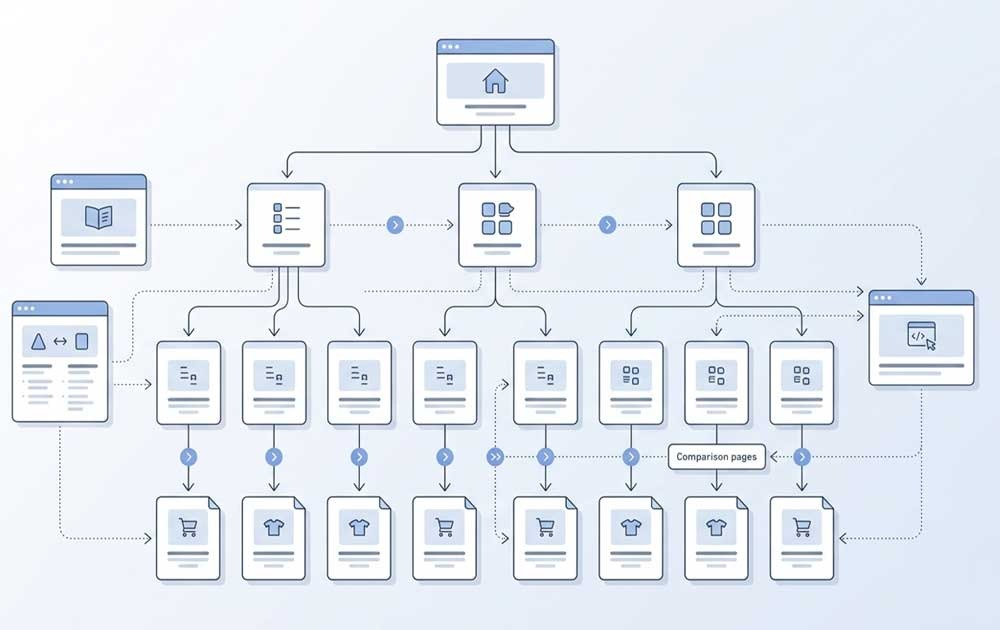
Most e-commerce structures are too simple. They follow a basic hierarchy where products sit under categories, and categories sit under the homepage.
This works at a small scale. It breaks when intent diversity increases.
A scalable architecture introduces multiple entry points into the system. Instead of forcing every user through product listings, the site captures users at different stages of decision-making.
A user researching options should land on a guide. A user comparing products should land on a structured comparison page. A user ready to buy should reach a product page without friction.
These pathways must exist inside the site structure, not as isolated content.
When architecture reflects user intent, search engines gain clarity. Pages stop competing and start supporting each other.
Intent Mapping Replaces Keyword Targeting
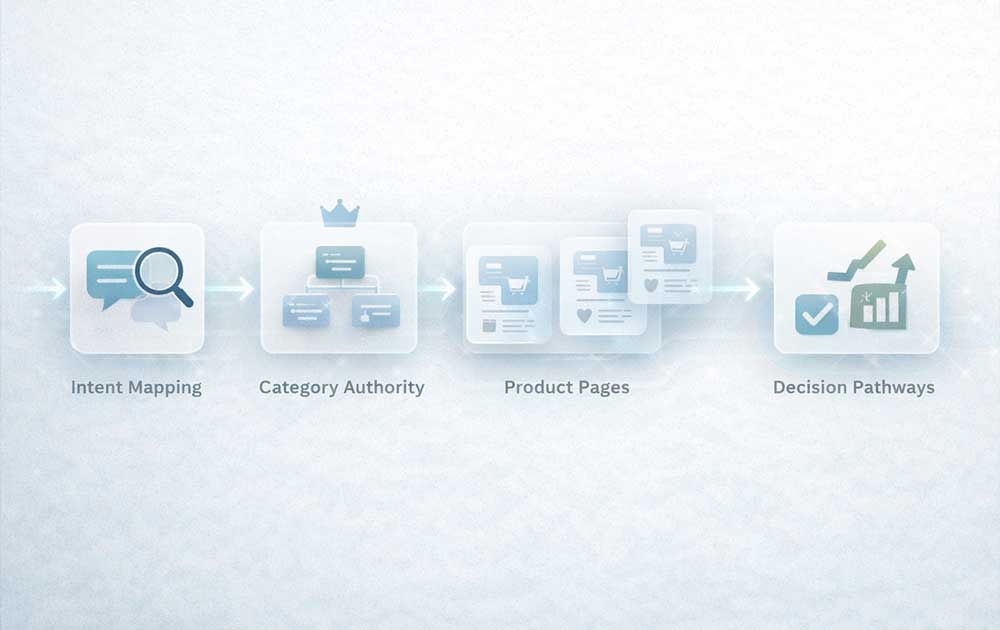
Keyword targeting treats search as static. Intent mapping treats it as a journey.
In e-commerce, users move through stages. They start with exploration, move into evaluation, and end with a transaction.
If your site only captures the final stage, you lose most of the opportunity.
Advanced SEO connects all stages inside one system. Informational pages feed into comparison pages. Comparison pages feed into category and product pages. Each layer prepares the user for the next step.
This is how authority builds naturally. Not from backlinks alone, but from structured relevance.
Category Pages as Authority Hubs
Category pages carry the highest strategic weight in most e-commerce sites. Yet they are often treated as simple product grids.
A strong category page introduces context. It explains what the user is looking at. It connects related subcategories. It directs users toward deeper decision content such as guides and comparisons.
From a search perspective, this transforms the page from a listing into an authority node.
When done correctly, category pages rank not only for transactional queries but also for broader commercial searches. This expands visibility without creating new pages.
Internal Linking as Infrastructure
Internal linking is not a finishing step. It is part of the system design.
In a structured e-commerce site, links follow predictable patterns. Products reinforce categories. Categories connect to related categories. Informational content supports both.
This creates directional flow. Authority does not stay isolated. It moves through the site.
Without this structure, even high-quality pages struggle to rank. With it, weaker pages gain strength from stronger ones.
The key difference is consistency. Random linking creates noise. Systematic linking creates clarity.
Controlling Faceted Navigation

Filters improve usability. They also create one of the biggest SEO risks in e-commerce.
Each filter combination generates a new URL. At scale, this results in thousands of near-duplicate pages.
If left uncontrolled, search engines waste crawl resources on low-value variations. Important pages get less attention.
The solution is not removing filters. It is controlling which versions matter.
High-intent combinations should remain accessible and indexable. Everything else should be consolidated through canonical signals or excluded from indexing.
This keeps the site focused and efficient.
Crawl Budget Optimization for Large E-Commerce Sites
When product count grows, crawl budget becomes a limiting factor.
Search engines do not crawl your entire site equally. They prioritize pages based on perceived importance and structure. If your site generates thousands of low-value URLs through filters, pagination, or duplicate variations, crawl resources get wasted.
This creates a hidden bottleneck. Important pages get discovered slower. Updates take longer to reflect in rankings. New products take more time to index.
Optimizing crawl budget starts with reducing noise.
Low-value pages should not compete with high-value ones. Faceted navigation must be controlled so only meaningful combinations remain accessible. Pagination should follow a clean structure where deeper pages remain reachable but do not dominate crawl priority.
Internal linking also plays a role here. Pages that receive more internal links are seen as more important. This means your architecture directly influences how search engines allocate attention.
Another critical factor is sitemap accuracy. Your XML sitemap should only include indexable, high-value pages. Including low-quality URLs sends mixed signals.
Crawl efficiency is not a technical detail. It is a scaling constraint. If ignored, growth slows regardless of how much content or how many products you add.
Product Pages That Compete in Search
Most product pages fail because they rely on manufacturer content. This creates duplication across multiple sites.
Search engines do not reward duplication.
A strong product page builds its own context. It explains use cases. It answers real questions. It connects to related products and supporting content.
Over time, this allows the page to rank for a wider set of queries, not only the product name.
This is how product pages move from being endpoints to becoming entry points.
Programmatic SEO for Scale
Manual optimization does not work when catalogs grow.
Programmatic SEO introduces controlled automation. It uses structured templates combined with data to generate pages at scale.
The risk is quality loss. Poor templates produce thin content.
The advantage comes when templates reflect real intent. For example, comparison structures or use-case variations that users already search for.
When done correctly, programmatic SEO expands coverage without breaking consistency.
Most SEO strategies assume content is stable. E-commerce does not work that way.
Products go out of stock. Categories change. Seasonal demand shifts. New items replace old ones. This constant movement creates SEO instability if not managed correctly.
Out-of-stock products are a common issue. Removing them entirely breaks existing rankings and backlinks. Keeping them without context creates poor user experience.
The correct approach depends on intent.
If a product will return, the page should remain active with clear status updates and alternative recommendations. If a product is permanently discontinued, it should redirect to the closest relevant category or replacement product.
Category pages must also adapt to inventory changes. If a category loses depth, its ranking potential drops. Maintaining category strength requires continuous alignment between inventory and search demand.
Seasonality introduces another layer. Some pages gain relevance only during specific periods. These pages should be maintained year-round, not recreated each season, so they retain authority over time.
E-commerce SEO is not static optimization. It is a continuous alignment between search intent and inventory reality. The stores that manage this well maintain stable rankings even as their catalog evolves.
Content as a Layered System
Content should not sit outside the store as a blog that rarely connects to products.
Instead, it should function as a layered system.
Top-level content captures attention. Mid-level content supports evaluation. Bottom-level pages drive transactions.
Each layer connects directly to the next. This reduces friction and increases conversion probability.
It also strengthens SEO. Search engines see a complete topical structure rather than isolated pages.
Technical SEO That Impacts Revenue
Many technical improvements have limited business impact. A few have direct effects.
Site speed is one of them. Slow pages reduce both rankings and conversions.
URL structure is another. Clean, consistent URLs help search engines understand relationships between pages.
Canonical signals prevent duplication. Structured data improves how pages appear in search results.
These are not optional optimizations. They are core components of a scalable system.
Structured Data and Search Visibility
Search results are no longer simple links.
Product listings often include ratings, prices, and availability. These elements increase visibility and click-through rate.
Structured data enables this.
For e-commerce, product schema and review schema are the most impactful. They do not change rankings directly, but they change how users interact with your listings.
Higher click-through rates translate into more traffic from the same position.
SEO and Conversion Alignment
Ranking alone does not generate revenue.
If the landing page does not match user intent, traffic leaves without converting.
Advanced SEO aligns page structure with user expectations. A comparison query leads to a comparison layout. A buying query leads to a clear product page.
This alignment reduces friction. It turns traffic into measurable results.
SEO Effort vs Business Impact
The pattern is clear. Structure-driven efforts produce the highest return.
Most businesses focus on content and links because they are visible. Structure is less visible, but far more influential.
Once structure is corrected, every new page contributes to growth instead of creating competition.
Keyword Clustering and Topical Authority
Single-keyword targeting creates fragmentation.
Clustering groups related queries into one strategic page supported by additional content.
This strengthens relevance. Search engines understand that the page covers a topic deeply, not superficially.
Over time, this builds authority in a way that isolated pages cannot achieve.
International SEO Considerations
Scaling into new markets introduces complexity.
Each region has different search behavior, language nuances, and pricing expectations.
A direct translation of content is not enough. Pages must reflect local intent.
Structure should remain consistent, but content should adapt.
This balance allows global growth without losing clarity.
Measuring Real SEO Performance
Ranking reports do not reflect business impact.
The metrics that matter are tied to revenue.
Organic traffic should be evaluated based on conversion rate and revenue contribution. Page-level performance reveals which parts of the system work and which need improvement.
This shifts SEO from a visibility metric to a business driver.
Final Perspective
E-commerce SEO becomes effective when it stops being a collection of tactics and becomes a system.
Structure defines how pages connect. Intent defines what pages exist. Linking defines how authority moves. Technical performance defines how efficiently everything works.
When these elements align, growth compounds. New products rank faster. Existing pages gain strength. The system improves itself over time.
This is the difference between constant effort and controlled scalability.
This is where businesses transition from chasing rankings to building sustainable growth engines, leveraging intelligent automation to transform SEO from a manual task into a scalable business asset.
Frequently Asked Questions
What is the most important factor in e-commerce SEO?
Site architecture has the highest long-term impact because it defines how everything else works together.
How does internal linking affect rankings?
It distributes authority across pages and helps search engines understand relationships within the site.
Is blog content necessary for e-commerce SEO?
Yes. It supports early-stage search intent and feeds users into commercial pages.
How do I avoid keyword cannibalization?
Use clear intent mapping and ensure each page has a distinct role within the structure.
Does technical SEO matter for small stores?
Yes. Early technical decisions affect how well the store scales later.
How long does advanced SEO take to show results?
Initial improvements appear within a few months, but full impact comes as the system compounds over time.


