
.avif)

Integrating AI with Google Ads for Smarter Campaign Management
Google Ads has reached a point where manual optimization alone no longer keeps campaigns competitive. User journeys are fragmented, data is continuous, and performance shifts faster than traditional reporting cycles. Many accounts still rely on delayed decisions, which leads to wasted budget and missed high-intent opportunities.
AI changes this dynamic by turning campaign management into a real-time decision system. Instead of reacting to past performance, advertisers start working with predictive signals and adaptive optimization.
At ZeroOne, we approach AI as a structural layer that connects data, targeting, bidding, and budget into a unified system. The result is not just better efficiency, but a more controlled and scalable way to manage growth.
Integrating AI with Google Ads means using machine learning, predictive analytics, automation, and performance data to make campaign decisions faster and more accurately. It helps businesses improve bidding, targeting, creative testing, budget allocation, and conversion tracking. The real value is not automation alone. It is smarter campaign management based on live data and business goals.
Why Google Ads Needs a Smarter Management Model
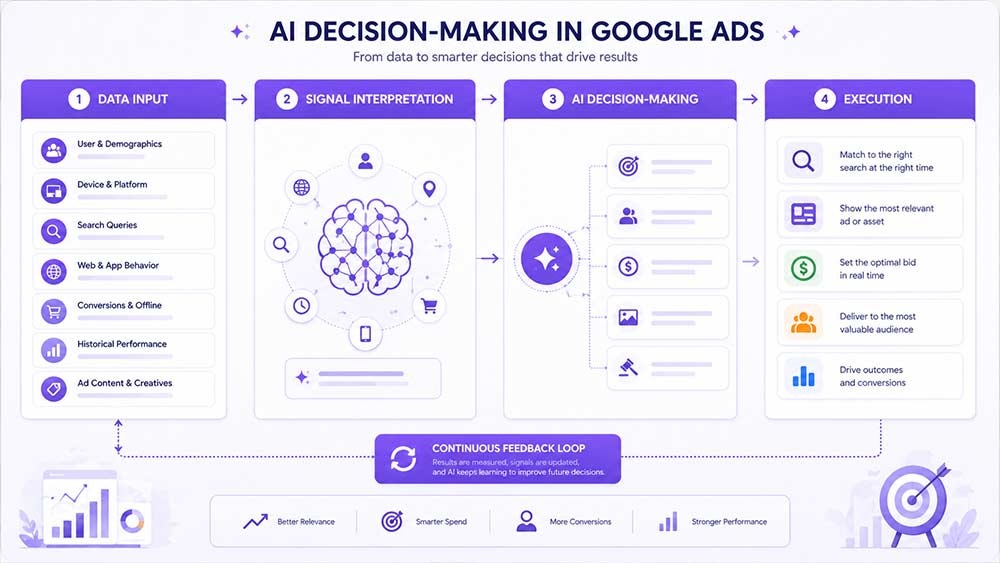
Infographic showing AI decision flow from data input to signal interpretation and campaign execution
Many businesses still manage Google Ads with a delayed feedback loop. They launch campaigns, wait for data, review reports, then make changes after performance has already shifted. This approach worked better when competition was lower and customer journeys were simpler.
Today, the cost of delay is higher. A campaign can waste a budget for several days before the problem becomes obvious. A keyword can look profitable at the surface level while attracting low-quality leads. A campaign can generate conversions, but those conversions may not turn into revenue.
This creates a serious problem. Google Ads accounts are often optimized for platform metrics instead of business outcomes.
A campaign manager might improve click-through rate while lead quality declines. Another might reduce cost per conversion while sales teams receive weaker leads. AI helps close this gap by looking beyond isolated metrics. It can compare signals across the full campaign journey and identify which actions are likely to create real value.
AI Does Not Replace Strategy. It Exposes Weak Strategy
One common mistake is treating AI as a shortcut. Businesses connect automation tools, activate smart bidding, launch Performance Max, and expect growth. But AI does not fix a weak offer, poor tracking, messy account structure, or unclear conversion goals.
In fact, AI often makes these weaknesses more visible.
If conversion tracking is wrong, AI learns from wrong signals. If all leads are counted equally, AI may optimize toward easy but low-value leads. If the campaign structure is too broad, AI may spend a budget where data volume is high but commercial intent is weak.
This is why AI integration should begin before automation. The first step is not choosing a tool. The first step is deciding what the campaign should actually optimize for.
For example, a B2B company should not treat every form submission as equal. A student, a spam lead, and a qualified enterprise buyer may all complete the same form. If the system only sees “conversion,” it cannot separate valuable demand from noise. AI becomes much more useful when CRM data, lead scoring, deal value, or sales qualification data is connected back into the advertising system.
That is where smarter campaign management starts.
The ZeroOne AI Campaign Framework
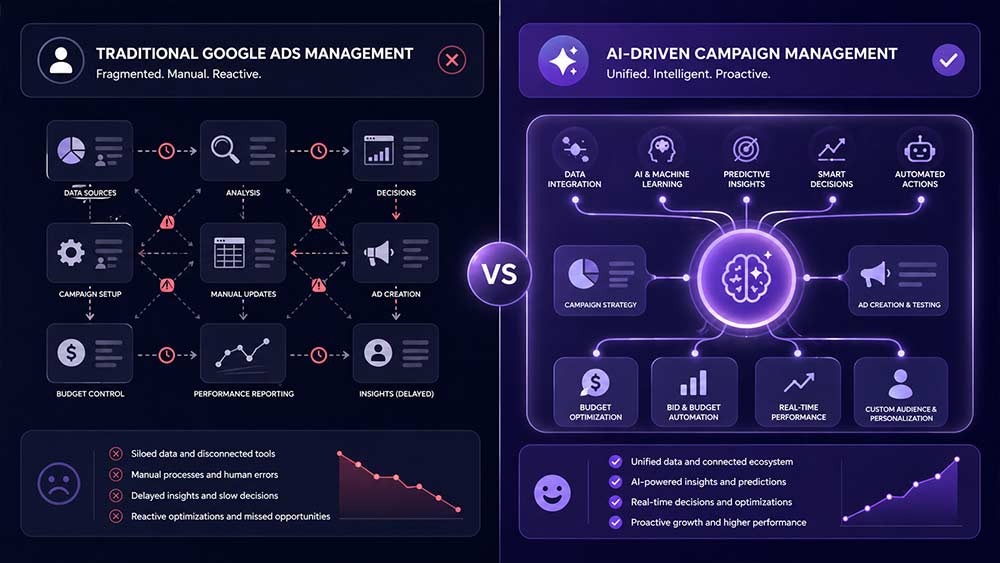
Most discussions around AI in Google Ads stop at features. Smart bidding, automation, Performance Max. These improve execution, but they do not explain why some campaigns scale while others collapse under the same tools.
At ZeroOne, we look at AI as a system, not a feature set. Campaign performance is not controlled by one lever. It is shaped by how data flows through multiple layers and how decisions are made across them.
We structure AI-driven Google Ads management into four connected layers: Data, Signals, Decisions, and Execution. When these layers are aligned, campaigns improve consistently. When one breaks, performance becomes unstable.
Data Layer: Defining What “Success” Means
The Data Layer is where most campaigns quietly fail. Not because data is missing, but because it is misleading.
Why Flat Conversion Tracking Breaks AI
Many accounts treat every conversion as equal. A form submission, a low-quality inquiry, and a high-value lead are all counted the same. From the system’s perspective, they carry identical values.
AI does not question this assumption. It learns from it.
This leads to a common pattern. Campaigns improve cost per acquisition, but sales quality declines. Volume increases, but revenue does not follow.
Connecting Google Ads to Real Business Value
For AI to make meaningful decisions, the Data Layer needs depth.
This means connecting:
- CRM data back into campaigns
- Lead qualification signals
- Revenue or deal value where possible
- Offline conversions
When the system understands which conversions matter, optimization shifts from volume to value.
Data Quality Is Not a Technical Detail
Data is not a setup task. It is a strategic decision.
If the Data Layer is weak, every layer above it becomes unreliable. AI does not fix this. It amplifies it.
Signal Layer: Turning Behavior Into Intent
Once the system has reliable data, the next challenge is interpretation.
The Signal Layer is where raw activity becomes meaningful patterns.
Why Metrics Alone Are Not Enough
Traditional reporting focuses on surface metrics. Click-through rate, bounce rate, conversion rate. These describe what happened, but not why it happened.
AI combines signals to understand context.
A user’s device, time of interaction, search query, previous visits, and engagement depth all contribute to intent. Looking at these signals in isolation hides the real picture.
From Segments to Behavioral Clusters
Instead of static audience segments, AI builds dynamic clusters.
Users are grouped based on behavior patterns, not just demographics or keywords. This allows campaigns to respond differently to different intent levels.
High-intent users receive more aggressive bidding. Low-intent users are filtered or deprioritized.
Detecting Hidden Performance Gaps
Many campaigns look stable on the surface but contain inefficiencies underneath.
The Signal Layer helps identify:
- Time windows where performance drops
- Devices that generate low-quality traffic
- Search patterns that attract weak leads
Without this layer, these inefficiencies remain invisible.
Decision Layer: Where Optimization Becomes Precise
The Decision Layer is where signals turn into action.
This is the core of AI-driven campaign management.
Moving From Rules to Probabilities
Manual optimization relies on rules. Increase bids, pause keywords, shift budget.
AI replaces this with probability-based decisions.
Each auction becomes a calculation. The system evaluates the likelihood of conversion and adjusts the bid in real time.
This level of precision is not possible with manual workflows.
Aligning Bidding With Business Outcomes
One of the biggest mistakes in AI adoption is optimizing for the wrong metric.
If the system is trained to optimize for conversions, it will find the cheapest conversions. Not the most valuable ones.
This is why the Decision Layer must align with:
- Revenue
- Qualified leads
- Customer lifetime value
When the objective is clear, AI decisions become meaningful.
Budget Allocation as a Continuous Process
The budget should not be fixed at the campaign level.
AI evaluates performance across campaigns and identifies where spend produces better results. It shifts budget accordingly.
This creates a more adaptive system where investment follows opportunity.
Execution Layer: Where Strategy Gets Applied
The Execution Layer is where decisions are implemented inside Google Ads.
This includes bidding adjustments, ad delivery, creative rotation, and campaign scaling.
Why Execution Alone Is Not Enough
Many advertisers focus only on this layer. They test ads, adjust budgets, and monitor performance.
But execution without strong data, signals, and decisions leads to inconsistent outcomes.
Changes are made, but the underlying system remains unstable.
Stabilizing Performance Through Structure
When the upper layers are aligned, execution becomes more predictable.
Campaigns adjust automatically based on structured inputs. Performance fluctuations decrease because decisions are based on consistent logic.
Scaling Without Losing Control
One of the biggest challenges in Google Ads is scaling without losing efficiency.
With a structured system, scaling becomes controlled. Budget increases follow performance signals, not assumptions.
This reduces the risk of sudden drops in return on ad spend.
Why This Framework Matters
Most AI discussions focus on tools. This framework focuses on structure.
Campaigns do not fail because AI is missing. They fail because the system around AI is incomplete.
When Data, Signals, Decisions, and Execution are aligned, AI becomes more than automation. It becomes a way to manage campaigns with clarity, consistency, and control.
This is where the real advantage appears.
If your campaigns rely on surface metrics, AI will optimize the wrong outcomes.
At ZeroOne, we redesign Google Ads systems around real business signals, not just platform data. This means connecting campaigns to revenue, lead quality, and actual performance drivers.
If you are scaling Google Ads and results feel inconsistent, it usually points to a structural issue, not an execution problem.
How AI Actually Makes Decisions in Google Ads

Most explanations of AI in Google Ads focus on what it does. Bidding, targeting, automation, testing. But the real advantage comes from how it makes decisions.
AI does not optimize one variable at a time. It processes multiple signals, evaluates probability, and applies decisions at different levels of the campaign simultaneously. This is what makes it fundamentally different from manual optimization.
Interpreting Signals Before Acting
AI does not start with action. It starts with interpretation.
Every user interaction carries multiple signals. Device, time, search intent, previous visits, engagement depth. On their own, these signals are weak. Combined, they form a pattern.
A campaign might look stable at a high level, but signal-level analysis often reveals inefficiencies. Certain time windows may generate low-quality leads. Specific devices may drive traffic that rarely converts into revenue. Some queries may attract volume without intent.
AI identifies these patterns early. It does not rely on surface metrics like average CPA or conversion rate. It evaluates context.
This is where most manual optimization falls short. Humans simplify data to make decisions. AI expands it.
Adjusting Bids at the User Level
Once signals are interpreted, AI moves to decision-making.
Bidding is no longer based on keyword averages or campaign-level performance. Each auction becomes a separate decision point.
The system evaluates the probability of conversion for a specific user at a specific moment. Based on that probability, it adjusts the bid in real time.
This changes how efficiency is achieved.
Instead of lowering bids across the board, the system becomes selective. It increases bids where intent is strong and reduces exposure where conversion likelihood is low.
The result is not just lower cost. It is better allocation of spend across users with different levels of intent.
Redistributing Budget Based on Opportunity
Budget allocation follows the same logic.
In many accounts, budgets are fixed at the campaign level. This creates rigidity. High-performing segments may be limited by budget caps, while weaker campaigns continue to spend.
AI removes this constraint.
It evaluates performance across campaigns, audiences, and time periods. When it detects stronger opportunities, it shifts spend toward them. When performance declines, it reduces exposure.
This creates a system where budget follows performance, not assumptions.
The key difference is timing. These adjustments happen continuously, not at the end of a reporting cycle.
Testing and Selecting the Right Message
Creative optimization is often treated as a separate task, but in AI-driven systems, it becomes part of the same decision loop.
Instead of testing a few ad variations manually, AI evaluates multiple combinations of headlines, descriptions, and audience contexts.
More importantly, it does not look for a single winning ad. It identifies which message works best for each segment.
A direct offer may perform well for high-intent users but fail with early-stage traffic. A technical message may attract qualified leads but reduce overall click volume.
AI detects these patterns and adjusts delivery accordingly.
This shifts creative strategy from static testing to adaptive messaging.
What a Smarter AI-Driven Google Ads System Looks Like

A strong AI-driven Google Ads system works as a continuous loop, not a set of separate actions.
Data defines what success means. Signals interpret user behavior. Decisions apply logic to bidding, targeting, and budget. Execution delivers those decisions through campaigns.
When these layers are aligned, performance becomes stable. Campaigns adjust based on real signals, not delayed reports or assumptions.
Tracking must reflect real business value, not just conversions. Campaign structure should separate intent and funnel stages. Bidding and budget decisions need to follow outcomes like revenue or qualified leads. Creative must provide enough variation for the system to learn.
AI handles scale and speed, but it does not replace context. Human input is still required to guide direction and interpret results.
Integrating AI with Google Ads is not about automation. It is about building a system that improves every decision over time.
The accounts that perform best are not the ones using more tools. They are the ones using better feedback loops.
Most Google Ads accounts do not fail because of poor execution. They fail because they optimize the wrong signals.
At ZeroOne, we build AI-driven campaign systems that connect data, decision-making, and performance into a single loop. This allows campaigns to scale without losing control.
If your current setup is generating traffic but not real growth, it may be time to rethink how your campaigns are structured.
FAQs About Integrating AI and Google Ads
Can AI fully manage Google Ads campaigns on its own?
No. AI improves execution and optimization, but strategy, goal definition, and interpretation of results still require human input.
How much data is needed for AI to work effectively?
Campaigns need consistent conversion data. Without enough volume and reliable tracking, AI cannot build accurate patterns.
Is Smart Bidding enough to get started with AI?
Yes, as a starting point. But long-term performance improves when deeper data like lead quality or revenue is fed into the system.
Does AI reduce advertising costs?
Not necessarily. The main goal is efficiency. In some cases costs decrease, in others spend increases with higher returns.
What is the biggest mistake when using AI in Google Ads?
Training the system on the wrong objective. If the data or conversion goals are flawed, AI will optimize toward low-value outcomes.

.png)
.png)

