
.avif)

SEO for Voice Search: Preparing for the Future
Search is no longer a browsing system. It is becoming a response system.
For years, SEO was built around visibility. You wanted to appear in a list of results, compete for position, and earn the click. That model assumed one thing: the user would evaluate options.
Voice search removes that assumption.
At ZeroOne, we see this shift less as a new feature and more as a structural change in how search works. Voice search removes that assumption entirely.
When a user speaks, they are not asking for options. They are asking for a decision. The system responds accordingly. It selects one answer and delivers it.
That single shift forces a deeper change than most teams expect. It changes what qualifies as “good content,” what gets surfaced, and what gets ignored completely.
Most pages today are still written for ranking. Voice search is not designed to rank them. It is designed to filter them.
Short Answer:
Voice search SEO is about restructuring content so that answers are immediate, clearly defined, and easy for systems to extract. Pages that win are not the most optimized for keywords. They are the easiest to interpret, isolate, and deliver as a direct response.
Voice Search vs Traditional SEO
The Shift From Interpretation to Precision

Traditional search operates on incomplete signals. A user types a short phrase, and the system must interpret what they might mean. This creates space for broad, generalized content to perform well, because ambiguity allows flexibility.
Voice search removes that ambiguity.
When someone asks a full question, intent is compressed into a single, precise signal. The system no longer needs to interpret broadly. It needs to match accurately.
This changes the type of content that performs. Pages that try to cover everything at once lose relevance. Pages that align tightly with a specific intent gain priority.
Precision replaces coverage as the dominant factor.
Why Ranking Logic Breaks Down in Voice Search
Ranking assumes multiple outcomes. It assumes the user will scan, compare, and choose between options.
Voice search removes that layer. There is no visible list. There is no comparison phase. The system makes the decision.
This introduces a different competitive model.
Instead of competing for position across a page, content competes at the level of individual answer segments. Each section of a page becomes a candidate. If it cannot function independently as a clear response, it is not considered.
This is why many well-ranked pages fail in voice search. Their structure depends on the user reading through the content. Voice systems do not read. They extract.
Extraction Is the Core Mechanism

To understand voice SEO, you have to understand extraction.
Search systems scan content and identify segments that can be lifted out and used as complete answers. These segments must be self-contained, coherent, and aligned with the query.
If an answer depends on surrounding paragraphs, it becomes difficult to extract. If it is delayed or buried, it becomes invisible.
Extraction prioritizes:
- clarity in the first lines
- direct alignment with the query
- minimal dependency on surrounding context
This is not a writing preference. It is a technical requirement.
The Structural Problem in Most Content
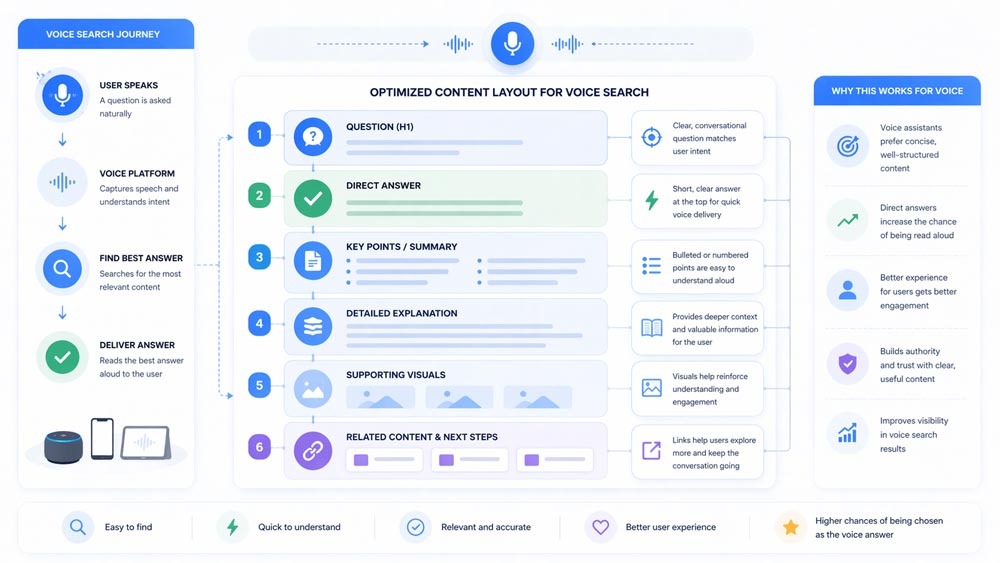
Most content is structured for narrative flow, not for answer isolation.
It introduces context first, builds explanation gradually, and delivers the core idea later. This format works in traditional reading environments, where users are willing to engage with the text.
Voice systems do not operate that way.
They need immediate clarity. If the first lines of a section do not answer the query, the system continues searching elsewhere.
This creates a structural mismatch between how content is written and how it is consumed.
Fixing this mismatch is the foundation of voice optimization.
Reordering Content Without Losing Depth
One of the common concerns is that direct answers reduce depth. In practice, the opposite is true.
A well-structured section delivers the answer immediately, then expands into detail. This creates a layered experience. The system extracts the top layer, while the user who continues reading receives deeper context.
The key is sequencing.
Answer first. Expand second.
This order feels abrupt from a stylistic perspective, but it aligns perfectly with how voice systems process content.
Natural Language as a Ranking Signal
Voice queries reflect how people actually think and speak. They include qualifiers, constraints, and intent signals in a single sentence.
Content that relies on rigid keyword placement often fails to match this structure.
The shift here is subtle but important. It is not about making content conversational. It is about making it structurally compatible with natural language queries.
Clear phrasing, direct statements, and logical sentence construction improve alignment. Overly complex or abstract language introduces friction.
This is where many technically optimized pages lose effectiveness. They are optimized for search engines as they used to be, not as they function now.
Local Context as a Layered Signal
Voice search frequently operates in contexts where location matters, even when it is not explicitly stated.
Queries like “nearest,” “open,” or “available” trigger location-based evaluation. The system combines content relevance with proximity and business data.
This introduces a multi-layered signal structure. Content quality alone is not enough. It must be supported by accurate and consistent local information.
Inconsistent listings, outdated data, or weak presence across platforms reduce the likelihood of selection, regardless of how strong the page content is.
Performance as a Filtering Mechanism
Speed and technical performance take on a different role in voice search.
In traditional SEO, performance influences ranking but does not always exclude a page. In voice search, it can act as a gate.
If a page cannot load quickly or respond efficiently, it may never enter the candidate pool for selection, which makes decisions around web design and software development directly impactful on search visibility.
This changes how technical optimization is prioritized. It is no longer about gaining an advantage. It is about meeting a baseline requirement to be considered.
The Limitation of Long-Form Content
Long-form content has been associated with authority and depth. That association still holds, but only when structure supports it.
Without structure, length becomes a liability. It increases the difficulty of extraction and reduces clarity.
Voice systems favor segments, not volume.
A shorter page with clearly defined sections and direct answers often outperforms a longer page that blends multiple ideas together.
The goal is not to reduce content. It is to organize it in a way that preserves clarity at every level.
Building Layered Answer Systems

Advanced voice optimization moves beyond single answers.
Instead of addressing one query, content is structured to cover a network of related questions. Each section targets a variation of intent, creating multiple entry points for extraction.
This approach increases the probability of selection across different queries. It also strengthens the overall topical authority of the page.
The key is separation.
Each question must have its own space, its own answer, and its own expansion. Overlap reduces clarity and weakens extraction signals.
Restructuring Existing Pages
Most websites already contain the necessary information. The issue lies in presentation.
Answers are often placed too deep within the content. Headings do not reflect real user queries. Sections combine multiple ideas without clear boundaries.
Restructuring focuses on making existing answers visible, which often requires more advanced SEO techniques to implement effectively:
This includes:
- converting headings into explicit questions
- placing answers at the beginning of sections
- breaking down long paragraphs into focused segments
- removing redundant or non-essential content
This process often delivers significant improvements without requiring new content creation.
Internal Context and Topic Architecture
Voice systems evaluate content within a broader context. They assess how well a page fits into a larger topic structure.
Internal linking plays a key role in defining this structure. It signals relationships between topics and reinforces relevance.
A page that exists within a clearly defined topic cluster carries more authority than one that stands alone, especially when supported by external signals like backlinks.
This is not about adding links arbitrarily. It is about building a coherent architecture where each page supports the others.
The Convergence With AI Systems
Voice search is increasingly integrated with AI-driven response systems.
These systems do not rely solely on static snippets. They synthesize answers from multiple sources, prioritizing clarity, consistency, and coverage.
This increases the importance of structured, well-defined content.
Pages that provide fragmented or shallow information are less useful in this environment. Pages that offer clear, layered, and well-organized content are more likely to be used as reference points.
The Risk of Inaction
Ignoring voice search does not result in immediate penalties. The impact is gradual.
Over time, pages lose visibility in high-intent queries. They are replaced by content that aligns more closely with extraction requirements.
Traffic may remain stable, but its quality declines. Conversion potential drops because the page is no longer present at the moment of decision.
This is not a ranking issue. It is a relevance issue.
Where This Is Going

AI-driven system delivering unified search answers
Search is moving toward fewer visible results and more direct answers.
Voice interfaces accelerate this trend. AI systems extend it further.
In both cases, the underlying requirement remains the same.
Content must be clear, structured, and easy to extract.
Pages that meet these criteria will continue to surface. Others will remain indexed but unseen.
Final Insight
Voice search does not reward effort, volume, or complexity.
It rewards clarity.
If your content delivers a precise answer immediately, it becomes usable. If it does not, it is ignored.
There is no middle ground.
If your content is not being selected, the issue is rarely visibility. It is structure.
See how ZeroOne approaches content structure and search performance, or reach out if you want a second look at your current pages.
Frequently Asked Questions About SEO for Voice Search
How do I know if my content is eligible for voice search results?
If a section of your page can answer a clear question in the first few lines without needing additional context, it is eligible. The easiest way to test this is to isolate a paragraph and see if it still makes sense on its own. If it does, it is structurally ready for extraction.
Do I need separate pages for voice search optimization?
No. In most cases, the issue is not content coverage but content structure. Existing pages can perform in voice search once they are reorganized around explicit questions with immediate answers.
Is conversational tone required for voice SEO?
Not necessarily. Clarity matters more than tone. Content should align with natural language patterns, but forcing conversational style without improving structure does not improve performance.
How important is schema markup for voice search?
Schema helps search engines understand your content faster, which supports extraction. It is useful, but it does not replace clear structure. Pages with strong structure perform better than pages that rely only on markup.
Can voice search drive high-quality traffic?
Yes, because voice queries are often more specific. Users who ask detailed questions are usually closer to making a decision, which increases conversion potential when the answer matches their intent.
What type of content performs best in voice search?
Content that is segmented into clear questions, delivers direct answers immediately, and expands with relevant detail performs best. Broad, unstructured articles are less effective.
How does page speed impact voice search performance?
Page speed acts as a filter. If a page loads slowly, it may not be considered for selection, even if the content is relevant.

.png)
.png)

