
.avif)
AI vs Machine Learning vs Deep Learning: What's the Difference?
Technology vendors love throwing around heavy buzzwords to sell their software. You've probably sat in a meeting where a sales rep used three different tech terms interchangeably in the same sentence and nobody in the room pushed back, because nobody wanted to be the one who asked.
That ambiguity has real consequences. When you don't understand the underlying technology, you risk overpaying for complex systems your team doesn't actually need, or underinvesting in capabilities that could genuinely move the needle.
So here's a straightforward breakdown of AI, machine learning, and deep learning what each one actually does, how they relate to each other, and what that means for practical business decisions.
A Quick Overview of the Three Concepts
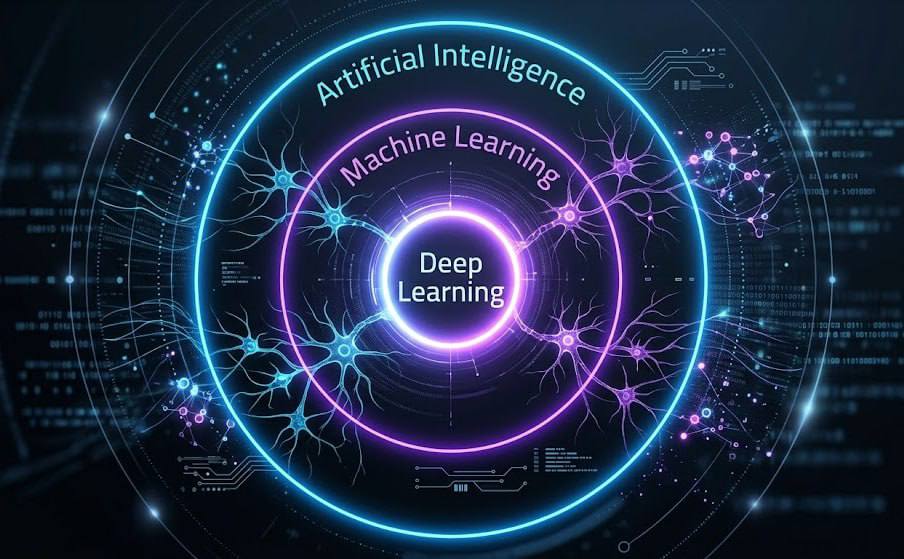
The easiest way to visualize the relationship between these three technologies is to picture a set of Russian nesting dolls. They're not three separate, competing technologies they're nested inside each other.
Artificial Intelligence is the largest, outermost doll. It represents the entire universe of smart computer systems.
Open that doll, and you find Machine Learning inside a smaller, more specific category of AI.
Open the Machine Learning doll, and at the very center sits Deep Learning the most specialized and technically complex subset of them all.
That nesting structure matters. It means every deep learning system is also a machine learning system, which is also AI. But not every AI system uses machine learning, and not every ML system uses deep learning. The categories have real boundaries, and understanding those boundaries is what helps you ask better questions when a vendor is pitching you their platform.
What is Artificial Intelligence (AI)?
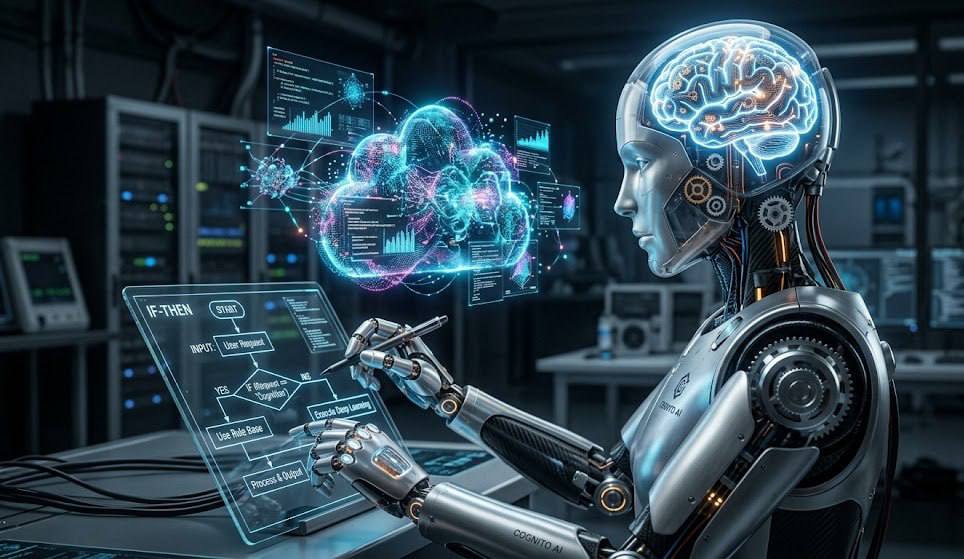
Artificial Intelligence is the broadest concept on the spectrum. It describes any computer system capable of performing tasks that normally require human intelligence recognizing patterns, making decisions, solving problems, understanding language.
The key word is broad. Early AI was built entirely on hardcoded rules. Programmers wrote thousands of lines of "if-then" logic: if a customer asks X, the chatbot replies with Y. The system looked smart because it could navigate complex decision trees but it couldn't learn, adapt, or handle a question it hadn't been pre-programmed to handle.
According to MIT Technology Review, the real breakthrough in AI came when developers stopped trying to encode every possible scenario and started letting machines learn from data instead. That shift is what gave rise to machine learning and eventually to everything that's come after.
AI as a category still includes those older, rule-based systems. But the AI most people are talking about today the kind powering recommendation engines, customer service bots, and fraud detection is running on machine learning.
What is Machine Learning (ML)?
This is where the software stops following strict rules and starts learning from experience. Machine Learning is a specific method used to achieve Artificial Intelligence.
Instead of hardcoding every single possible scenario, developers feed massive amounts of data into an algorithm. The algorithm analyzes this data, identifies historical patterns, and builds its own mathematical model to predict future outcomes.
Machine Learning typically falls into two main categories:
- Supervised Learning: Humans train the algorithm using labeled data. For example, feeding a system ten thousand images explicitly labeled "spam" so it learns to filter your inbox.
- Unsupervised Learning: The algorithm receives raw, unlabeled data and must find hidden structures on its own, such as grouping your customers into distinct purchasing segments based on subtle behavioral trends.
There's a third category worth knowing reinforcement learning, where the algorithm learns by trial and error, receiving rewards for correct decisions and penalties for wrong ones. This is what powers game-playing AI and is increasingly used in robotics and logistics optimization.
Most of what businesses actually use day-to-day falls under supervised learning: churn prediction, lead scoring, demand forecasting, recommendation engines. If you're evaluating AI tools for your operations, this is probably the category that's most relevant.

What Is Deep Learning (DL)?
Deep learning sits at the cutting edge the most mathematically complex, computationally demanding, and capable subset of machine learning.
Standard ML algorithms plateau at some point. Feed them more data beyond a certain threshold and performance stops improving. Deep learning models don't have that ceiling. They actually get smarter the more data you feed them, which is one reason they've become the backbone of so many modern AI applications.
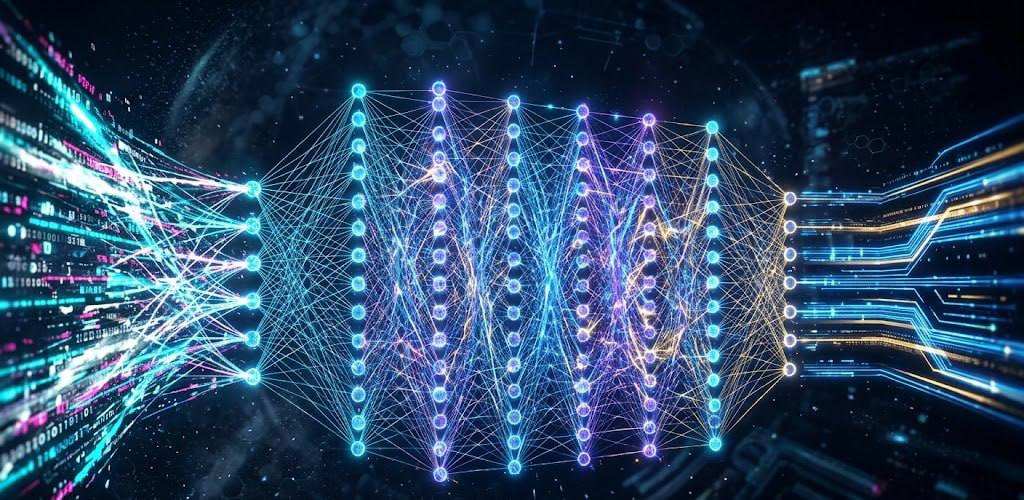
They achieve this through structures called Artificial Neural Networks architectures loosely inspired by how biological neurons in the human brain connect and communicate. As IBM's technical documentation on neural networks explains, these models stack multiple layers of interconnected processing nodes. Data enters through an input layer, passes through dozens or hundreds of "hidden" layers where patterns are progressively abstracted, and emerges as a highly accurate output.
That layering is what enables deep learning to handle tasks that were essentially impossible for earlier ML approaches: reading handwritten text from a photo, recognizing a face in a crowd, transcribing speech in real time, generating realistic images from a text description.
The tradeoff is significant cost and complexity. Training a serious deep learning model requires GPU clusters, massive datasets, weeks of compute time, and specialized engineering talent. For most business applications, that level of infrastructure is overkill and recognizing that distinction is genuinely useful when evaluating technology vendors.
AI vs ML vs DL: A Side-by-Side Comparison
To truly master the debate of AI vs machine learning vs deep learning, you need to look at how each level handles technical constraints.
Understanding these operational boundaries dictates exactly which tool you need to solve a specific business problem.
Scope
When analyzing AI vs machine learning vs deep learning, scope is the biggest differentiator. AI is a blanket term for any smart system. ML narrows the focus strictly to algorithms that improve through data exposure. DL narrows it even further to algorithms utilizing multi-layered neural networks.
Data Requirements
A basic AI chatbot operates perfectly fine with a small spreadsheet of frequently asked questions. Machine Learning algorithms demand thousands of data points to become statistically accurate. Deep Learning models are notoriously data-hungry; they require millions of data points—like massive libraries of raw video or audio—to function correctly.
Real-World Applications
A standard AI application is the automated opponent you play against in a video game. A classic Machine Learning application is Spotify recommending a new playlist based on your listening history. A Deep Learning application is a medical imaging system diagnosing early-stage tumors from an MRI scan faster than a human doctor.
How They Work Together in Modern Business
You rarely purchase these technologies in isolation. In a modern corporate environment, they stack on top of each other to create seamless, highly efficient automated workflows.
At ZeroOneTech, we frequently see executives getting bogged down in the textbook definitions of AI vs machine learning vs deep learning when they really just want operational results. Here is exactly how these technologies combine to scale a growing business:
- Data Intake (DL): A deep learning neural network scans incoming paper invoices and accurately extracts the handwritten text.
- Analysis (ML): A machine learning algorithm reviews those invoices, compares them against historical vendor data, and flags any unusual pricing anomalies for fraud review.
- Execution (AI): A broader AI automation system takes the approved data and automatically routes it into your custom ERP or Zoho One financial dashboard for payment.
If you want to see exactly how these stacked technologies can revolutionize your daily operations, we highly recommend reading our foundational guide on What is AI Automation?.
Final Thoughts
The technological landscape is shifting incredibly fast, but the fundamental concepts remain stable. You do not need to hold a degree in data science to leverage these tools effectively.
When you strip away the heavy jargon surrounding AI vs machine learning vs deep learning, you are simply looking at a powerful progression of software capabilities. We moved from computers that follow rigid rules, to computers that learn from historical data, to computers that can independently recognize complex global patterns.
At ZeroOneTech, we build the custom digital infrastructure that brings these capabilities to life. Whether you need a deeply customized CRM integration or an intelligent Power BI dashboard, focusing on the business outcome rather than the technical label is always the smartest strategy.
FAQs
1) Is machine learning a part of AI?
Yes. Machine learning is a direct subset of artificial intelligence. While all machine learning is considered AI, not all AI utilizes machine learning. Some basic AI systems still rely on simple, hardcoded rules rather than learning algorithms.
2) What's the simplest way to explain deep learning?
It is a highly advanced type of machine learning inspired by the human brain. Instead of a simple algorithm, it uses layers of artificial "neurons" to process massive amounts of unstructured data—like video, audio, or human speech—making its own independent connections.
3) Which one should businesses focus on?
Most businesses should focus heavily on standard Machine Learning. It provides the highest immediate ROI for practical business needs, such as predictive sales forecasting, automated inventory management, and customer behavior analysis without requiring multi-million dollar computing hardware.
4) Can you have AI without machine learning?
Yes. Early artificial intelligence relied on "expert systems." These were massive databases of "if-then" rules created by human programmers. The system appeared intelligent because it could navigate a complex decision tree, but it possessed absolutely zero ability to learn or adapt.
5) Are AI and ML the same thing?
No, though the media frequently uses them interchangeably. AI is the broad goal of creating smart machines. ML is the specific, data-driven method we use today to actually achieve that goal.

.png)
.png)

