


Keyword Research Tools: Free vs. Paid Options Compared
Most SEO strategies do not break at execution. They break earlier, at the point where decisions are made.
Keyword research defines direction. If the data behind that research is incomplete, every decision built on top of it carries risk. Teams often assume they are targeting the right queries, competing in the right spaces, and building content in the right structure. In reality, they are working with a filtered view of the market.
At ZeroOne, this pattern appears consistently across growing teams. They start with free tools, validate a few ideas, publish content, and see early traction. Then growth slows down. Not because the market disappears, but because visibility into that market is limited.
Quick Answer:
Free keyword research tools are effective for early validation and basic SEO tasks. Paid tools provide deeper datasets, accurate competition analysis, and structured keyword relationships. Once SEO becomes a serious growth channel, relying only on free tools limits scalability and decision quality.
Core Comparison: Free vs Paid Keyword Tools
Understanding the Role of Free Keyword Tools
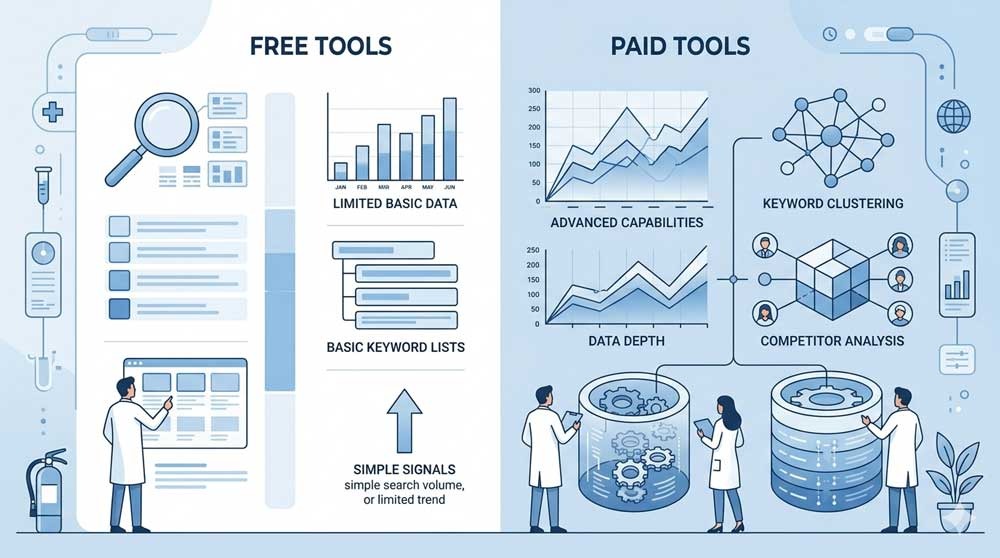
Free keyword tools exist for a reason. They reduce friction at the start of the process. They allow individuals and teams to explore ideas without committing resources. This makes them valuable in early-stage SEO, where the goal is not precision, but direction.
At this stage, the primary question is simple. Is there search demand for this topic. Free tools answer that question quickly. They show related queries, basic trends, and general interest levels. For someone testing a niche or validating a content idea, this is enough.
The limitation is not obvious at first. It becomes visible only when expectations change. When SEO shifts from exploration to growth, the same tools begin to show their constraints.
Most free tools rely on partial datasets. Some pull from autocomplete suggestions. Others use restricted APIs with capped data. This results in a simplified representation of the search landscape. You are not seeing the full range of queries, nor the true distribution of competition.
This is not a flaw. It is a design tradeoff. Free tools prioritize accessibility over depth.
The Structural Limitations That Slow Growth
As content production increases, the gap between perception and reality becomes more significant. Teams begin to rely on keyword metrics that are incomplete. Difficulty scores lack context. Search volumes are broad estimates. Relationships between keywords remain hidden.
This creates a subtle but critical problem. Decisions feel informed, but they are not fully grounded in reality.
A keyword might appear low competition, but the actual search results may be dominated by authoritative domains. Another keyword may seem unimportant, yet represent a cluster of long-tail queries with meaningful traffic. Without visibility into these layers, prioritization becomes inconsistent.
This inconsistency compounds over time. Content is published without a clear structure. Pages compete against each other instead of supporting one another. Opportunities remain undiscovered because the tool does not surface them.
At this point, many teams question the effectiveness of SEO itself. The assumption is that the channel is unpredictable. In reality, the unpredictability comes from limited data.
What Paid Tools Introduce to the Process
Paid keyword research tools do not simply provide more data. They change how that data is organized and interpreted.
Instead of presenting keywords as isolated entries, they reveal connections. Topics are broken down into clusters. Search intent becomes clearer through analysis of actual search results. Competitor performance is no longer hidden.
This shift transforms the role of keyword research. It moves from a tactical activity to a strategic one.
With access to deeper datasets, teams begin to understand how topics are structured. They see how multiple queries relate to a single intent. They identify which areas are saturated and which remain underdeveloped.
This allows for deliberate planning. Content is no longer created in isolation. It is mapped within a system where each piece contributes to a broader objective.
Data Accuracy and Its Impact on Strategy

Accuracy in keyword data is often underestimated. The assumption is that approximate numbers are sufficient. For small-scale decisions, this may hold true. For larger strategies, it becomes a limiting factor.
When data is incomplete, every decision includes hidden uncertainty. A keyword chosen based on inaccurate volume may not justify the effort. A difficulty score that lacks depth may lead to underestimating competition.
Paid tools reduce this uncertainty. They do not eliminate it entirely, but they provide a more reliable foundation. Search volumes are derived from larger datasets. Difficulty metrics consider actual ranking domains. Trends reflect broader patterns rather than isolated signals.
This leads to better prioritization. Instead of spreading effort across uncertain opportunities, teams focus on areas with clearer potential. Over time, this improves efficiency and consistency in results.
From Keywords to Topic Systems
One of the most important differences between free and paid tools is how they represent relationships between queries.
Free tools typically generate lists. Paid tools generate structures.
This distinction directly affects how content strategies are built. When keywords are treated individually, content remains fragmented. Each page targets a specific query without considering how it connects to others.
When keywords are organized into clusters, a different approach emerges. A central topic is supported by multiple related pages. Each page addresses a variation of intent, contributing to the overall authority of the site in that area.
Search engines recognize this structure. Instead of evaluating pages in isolation, they assess how comprehensively a topic is covered. Sites that demonstrate depth and consistency across related queries are more likely to rank.
This is the foundation of topical authority. It cannot be built effectively without visibility into keyword relationships, which is where paid tools provide significant value.
The Role of Competitor Analysis
SEO does not exist in a vacuum. Every keyword is part of a competitive environment. Understanding that environment is essential for effective decision-making.
Free tools offer limited insight into this layer. They may show general difficulty levels, but they rarely explain why a keyword is competitive or who dominates it.
Paid tools provide clarity. They reveal which domains rank for specific queries, how much traffic those pages receive, and what kind of content performs well. This allows teams to assess feasibility before committing resources.
More importantly, competitor analysis highlights gaps. These are areas where demand exists but coverage is weak or inconsistent. Identifying such gaps allows for strategic entry into the market.
Without this visibility, teams rely on assumptions. With it, they operate with context.
Practical Example

Consider a business targeting the keyword “project management software.” A free tool might show decent search volume and label it as moderately competitive. Based on that, the team creates a single article and expects traction.
In reality, the search results are dominated by high-authority domains, comparison pages, and established SaaS brands. The page struggles to rank, and the effort produces little return.
With a paid tool, the same topic looks different. Instead of one keyword, it expands into clusters such as “project management tools for small teams,” “best project management software for remote work,” and “free project management tools with time tracking.” Each of these represents a clearer intent and a more accessible entry point.
Instead of competing directly in a saturated space, the team builds a structured set of pages targeting these clusters. Over time, these pages reinforce each other, build topical authority, and create a pathway to compete for broader terms.
When the Shift to Paid Tools Becomes Necessary
The transition from free to paid tools is not driven by budget. It is driven by the role SEO plays in the business.
In early stages, when SEO is experimental, free tools are sufficient. They support learning and exploration. The cost of incorrect decisions is low because the scale is limited.
As SEO becomes a consistent investment, the cost of inaccuracy increases. Content production requires time, effort, and often financial resources. At this point, decisions need to be more reliable.
This is where paid tools become necessary. They provide the level of detail required to support consistent growth. They allow teams to move from reactive content creation to structured planning.
At ZeroOne, this shift is typically observed when teams begin publishing regularly and expect measurable outcomes. Once performance matters, data quality becomes critical.
Paid Tools Landscape
Not all paid keyword tools serve the same purpose. Some focus on large-scale data aggregation, others on competitor intelligence, and a few are built around content structuring. Tools like Ahrefs and SEMrush are often used for deep backlink and competitor analysis, while platforms such as KWFinder or Ubersuggest provide a more accessible entry point for keyword discovery. The choice is not about which tool is “best,” but which one aligns with the level of analysis your strategy requires.
Strategic Perspective: Tool Choice by Growth Stage
The Hidden Cost of Relying Only on Free Tools

At a glance, free tools appear cost-effective. There is no financial commitment, and the initial results seem acceptable.
The real cost emerges over time.
Content created based on incomplete data often fails to perform. Opportunities that could generate traffic remain undiscovered. Effort is distributed across areas with limited return.
These inefficiencies are not always visible immediately. They accumulate gradually, affecting overall performance.
In contrast, teams using more comprehensive data make fewer missteps. They allocate resources more effectively and achieve results with greater consistency.
The difference is not just in outcomes, but in the path taken to reach them.
Final Insight
The choice between free and paid keyword research tools reflects how SEO is approached.
Free tools support exploration. They provide enough visibility to test ideas and understand basic demand.
Paid tools support execution. They provide the depth and context required to build systems that scale.
The transition between the two marks a shift in mindset. From experimenting with content to building a structured growth engine.
If you like this article, you might like to read this one, too:
Paid Ads Media That Converts.
FAQ
Are free keyword tools enough for long-term SEO?
They work in early stages, but their limitations make long-term scaling difficult, especially in competitive markets.
What makes paid tools more effective?
They provide deeper datasets, accurate competition analysis, and structured keyword relationships that support strategic planning.
Can small websites benefit from paid tools?
Yes, if SEO is a primary growth channel and consistent content production is planned.
Is keyword difficulty reliable in free tools?
It is often simplified and may not reflect real competition in search results.
When should a business invest in paid keyword tools?
When SEO moves from experimentation to a consistent growth strategy and requires reliable data for decision-making.


