


CRM Trends in 2026: AI Chatbots and Predictive Lead Scoring
Five years ago most CRM systems functioned as organized databases. They stored contacts, tracked deals, and helped sales teams record interactions with customers.
In 2026 that role has changed completely.
Modern CRM platforms increasingly behave like decision engines. Instead of simply storing information, they analyze behavioral signals, predict which leads are most valuable, and automate the first stages of customer engagement.
This shift is happening because the sales environment has changed. Prospects now research products extensively before contacting a company. When they finally reach out, they expect immediate responses and highly relevant communication.
Companies that fail to respond quickly often lose opportunities before a salesperson even sees the lead.
Two technologies are driving this transformation more than any others:
AI chatbots and predictive lead scoring.
AI chatbots capture visitor intent and gather structured information during the first interaction. Predictive lead scoring analyzes historical CRM data and behavioral signals to estimate which prospects are most likely to become customers.
Together these capabilities turn a traditional CRM into a revenue intelligence system that actively guides sales activity instead of passively recording it.
Stay with ZeroOne so we can discover these trends deeply.
What Are The Most Important Trends of 2026 in CRM
The most important CRM trend in 2026 is the shift toward AI-driven sales intelligence.
AI chatbots manage early customer interactions by answering questions, qualifying leads, and collecting structured data directly inside the CRM system. Predictive lead scoring then analyzes behavioral patterns and historical deal data to estimate conversion probability.
This combination allows businesses to prioritize high-value prospects, respond faster to customer inquiries, and increase sales efficiency.
Organizations that adopt these capabilities move from basic contact management toward data-driven revenue operations.
Why CRM Is Changing So Quickly
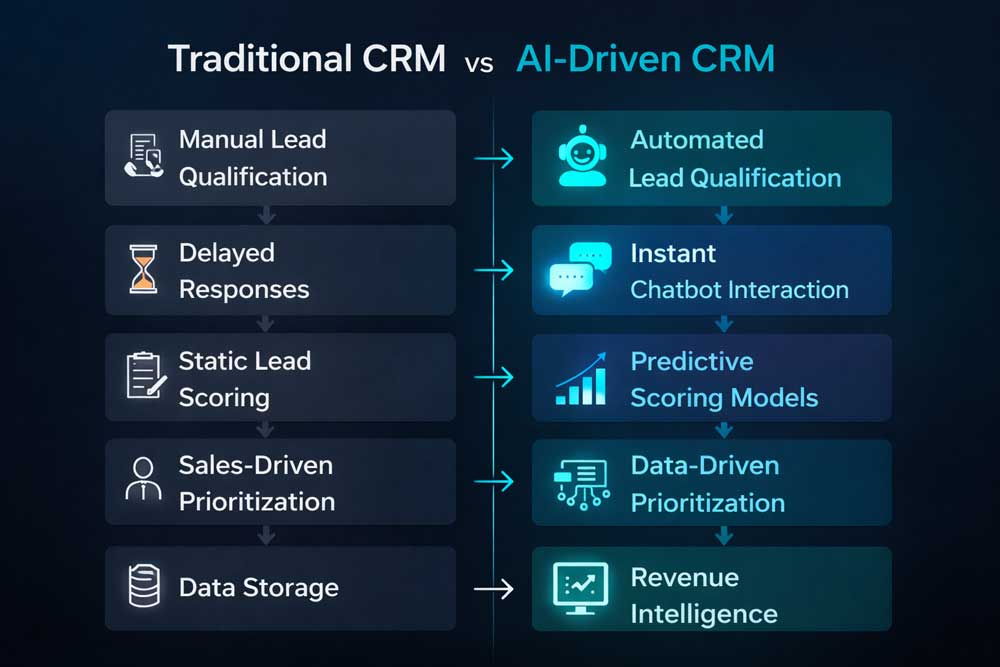
Customer behavior has changed significantly in the past decade. Buyers now perform extensive research before speaking with a salesperson. By the time a prospect contacts a company, they often already understand the product category, the competitors, and the approximate price range.
This shift creates a major challenge for businesses.
If a company responds slowly, fails to recognize buying intent, or contacts the wrong prospects first, it loses opportunities. Traditional CRM systems struggle to support modern sales processes because they rely heavily on manual work.
Sales representatives must review leads, decide which prospects deserve attention, and initiate communication themselves. This process consumes time and introduces human bias into lead prioritization.
Modern CRM platforms solve this problem by introducing automation and predictive analysis.
Instead of waiting for manual decisions, the CRM system evaluates data continuously and recommends the next action. AI chatbots gather information from visitors. Predictive algorithms analyze the collected data and rank prospects based on purchasing probability.
This shift explains why AI-driven CRM features have become one of the fastest growing segments in enterprise software.
The Role of AI Chatbots in Modern CRM Systems

AI chatbots now play a central role in how companies capture and qualify leads. Unlike early chatbot implementations that relied on simple scripts, modern AI chatbots operate using natural language processing and contextual analysis.
When a visitor enters a website, the chatbot begins the first interaction. It greets the visitor and offers assistance. The conversation usually focuses on a few essential topics.
• the visitor’s goal
• the type of product or service they need
• the timeline for purchase
• company size or industry category
Each response becomes structured data inside the CRM system.
This process creates an immediate customer profile before any salesperson enters the conversation.
The operational advantages are significant. Businesses no longer rely on web forms that prospects often ignore. Instead, conversations collect the same information in a more natural way.
Another major benefit involves response speed. Many studies show that the probability of converting a lead declines sharply when response time increases. Prospects often contact multiple companies at the same time. The organization that responds first usually gains a competitive advantage.
AI chatbots ensure that no visitor waits for a response. The system operates continuously, even outside normal business hours.
What CRM Chatbots Actually Do
Although chatbots often appear simple to users, their role inside the CRM system is complex. They perform several operational functions simultaneously.
By the time a human salesperson enters the conversation, the system already contains valuable information about the prospect’s needs and intentions.
This allows sales teams to focus on higher value interactions rather than basic information gathering.
Predictive Lead Scoring: From Guesswork to Data Science

Lead scoring has existed in marketing systems for many years. Traditional models assign points to specific actions such as opening an email, visiting a webpage, or downloading a document.
Although this method provides basic prioritization, it relies heavily on assumptions.
Predictive lead scoring replaces these assumptions with machine learning analysis.
Instead of assigning fixed point values, the system studies historical CRM data. It examines past deals and identifies patterns that appeared before successful conversions.
For example, the system may detect correlations between:
• industry category
• company size
• engagement frequency
• website browsing behavior
• product interest signals
The algorithm then uses these patterns to evaluate new leads entering the CRM system.
Each lead receives a probability score that represents how likely that prospect is to become a customer.
This score allows sales teams to prioritize their efforts more efficiently.
Comparing Traditional and Predictive Lead Scoring
The difference between manual scoring systems and predictive models is substantial.
Predictive models continuously improve as new data enters the system. Each closed deal provides additional information that strengthens the algorithm’s accuracy.
Over time, this creates a self-improving sales intelligence system.
Why These Trends Matter for Growing Businesses
The practical impact of these technologies appears in several areas of business performance.
First, response time improves dramatically. AI chatbots ensure that every visitor receives immediate attention.
Second, sales teams spend less time evaluating low value leads. Predictive scoring highlights prospects that deserve priority.
Third, marketing and sales alignment improves because both teams rely on the same behavioral data.
Organizations that adopt these technologies early often gain a measurable competitive advantage. They engage prospects faster and focus resources on opportunities with the highest potential value.
This transformation explains why CRM modernization has become a strategic priority for many companies.
When Chatbots and Predictive Scoring Work Together
The real transformation in CRM systems happens when AI chatbots and predictive lead scoring operate as a unified workflow.
Most organizations initially adopt these tools separately. Chatbots handle website conversations while predictive models analyze marketing data. However, the strongest operational impact appears when both systems exchange data in real time.
The process usually unfolds in several stages.
First, the chatbot interacts with a visitor and gathers information about the prospect’s needs, company size, industry, and purchase timeline. Instead of sending this information to a simple contact database, the system immediately feeds it into the CRM platform.
Next, the predictive scoring model evaluates this information together with behavioral signals. These signals may include pages visited, time spent on the site, content downloads, and interaction frequency.
Within seconds, the CRM calculates a lead probability score.
This score determines what happens next.
This automation removes a major bottleneck in traditional sales workflows. Sales representatives no longer waste time evaluating every new lead manually.
Instead, the CRM system directs their attention toward prospects with the highest conversion potential.
Why Response Speed Is Now a Competitive Advantage
Response speed has become one of the most influential factors in modern sales environments.
Prospects rarely contact only one vendor. Most buyers evaluate several companies simultaneously. The first company that responds with helpful information often gains a psychological advantage.
Traditional CRM processes make rapid response difficult. When a prospect submits a form or sends a message, the request usually enters a queue that requires manual review.
AI chatbots eliminate this delay.
Instead of waiting for human intervention, the system begins interacting with the visitor immediately. It answers basic questions, collects contact information, and schedules meetings when appropriate.
This approach creates two important improvements.
The first improvement is operational efficiency. Sales teams spend less time handling repetitive inquiries.
The second improvement is customer perception. Prospects feel that the company is responsive and organized.
Both factors contribute to higher conversion rates.
Popular AI Chatbot Platforms Used in Modern CRM Systems

Several well-known platforms have shaped how businesses deploy AI chatbots inside CRM environments. These tools integrate conversational interfaces with customer data, allowing companies to capture leads, qualify prospects, and route conversations to the appropriate sales teams.
Intercom
Intercom focuses on conversational customer engagement. Businesses often use it for automated onboarding, product support, and early-stage lead qualification. Its messaging system connects directly with customer profiles and behavioral data.
Drift
Drift specializes in conversational marketing. The platform enables companies to capture website leads through automated conversations and schedule meetings with sales teams in real time. Many B2B organizations use Drift to reduce response delays during the early stages of the sales funnel.
HubSpot Chatbot Builder
HubSpot Chatbot Builder integrates chatbot automation directly inside its CRM platform. Businesses use it to qualify leads, route conversations, and trigger marketing workflows based on visitor behavior. Because it operates within the HubSpot ecosystem, all conversation data feeds directly into CRM contact records.
Tidio
Tidio is widely used by small and mid-size companies that want to deploy chatbots quickly. The platform combines live chat with AI automation and integrates with ecommerce and CRM tools for customer support and lead capture.
Platforms like these demonstrate how conversational interfaces have become a core component of modern CRM systems. Instead of relying only on web forms or delayed email responses, businesses now capture customer intent through real-time conversations and structured CRM data.
CRM Automation and the Risk of Poor Implementation
Although AI-driven CRM systems offer significant advantages, poor implementation can create new problems.
Automation without proper design often produces inaccurate lead scoring or confusing customer experiences.
Several common mistakes appear during CRM modernization projects.
Incomplete Data Structures
Predictive models rely on historical CRM data. If the existing data contains missing fields, inconsistent formats, or outdated information, the scoring model becomes unreliable.
Organizations often underestimate the effort required to clean and structure CRM datasets before deploying machine learning models.
Fragmented System Integrations
CRM systems rarely operate in isolation. They must integrate with marketing platforms, analytics tools, customer support systems, and websites.
When these integrations are poorly configured, important behavioral signals never reach the CRM database. The predictive model then operates with limited information.
Over-Automation
Automation improves efficiency when used carefully. However, excessive automation can remove the human judgment required in complex sales processes.
For example, high-value enterprise deals still require personalized communication and relationship development.
The most effective CRM implementations combine automation with strategic human oversight.
Industry Adoption Patterns
CRM modernization does not occur at the same speed across all industries.
Technology companies and software providers usually adopt AI-driven CRM tools earlier because their sales processes already rely heavily on digital engagement.
Professional services firms, financial institutions, and B2B consulting organizations follow closely behind.
Retail and traditional manufacturing companies often adopt these technologies more slowly because their CRM processes historically depended on offline interactions.
However, this gap continues to narrow.
As digital marketing becomes central to customer acquisition, even traditionally offline industries are investing in predictive CRM capabilities.
Strategic Hot Take: CRM Is Becoming a Revenue Intelligence Platform
Many organizations still treat CRM systems as administrative tools. Sales teams update deal stages, store notes, and track contacts.
This approach misses the strategic potential of modern CRM platforms.
In reality, CRM systems are evolving into revenue intelligence platforms.
Instead of merely recording sales activity, these systems analyze patterns across the entire customer journey. They evaluate marketing campaigns, predict pipeline growth, and identify behavioral signals that indicate purchasing intent.
This transformation changes the role of CRM from a passive record system into an operational control center.
Companies that understand this shift treat CRM architecture as core infrastructure rather than optional software.
Those that do not often struggle with fragmented sales processes and inconsistent customer experiences.
How Businesses Should Prepare for AI-Driven CRM
Organizations planning CRM modernization should approach the project as a strategic transformation rather than a software upgrade.
Three priorities usually determine the success of these initiatives.
Build a Reliable Data Foundation
Predictive analytics requires structured and consistent data. Businesses should review existing CRM records and standardize important fields before deploying advanced models.
Design Clear Automation Workflows
Automation must support real business processes. Each step in the sales funnel should correspond to specific CRM actions and automated tasks.
Integrate Marketing, Sales, and Customer Data
Customer insights often exist across multiple platforms. Integrating these systems ensures that predictive models receive a complete dataset.
Companies that follow these principles usually achieve significantly higher adoption rates for CRM technology.
The Role of CRM Consulting and System Architecture
Many companies attempt CRM modernization using default configurations from software vendors.
While these basic setups work for small teams, growing organizations usually require customized workflows and deeper integration.
Professional CRM consulting services often help businesses design systems aligned with their operational processes.
Typical consulting projects include:
Companies that invest in proper CRM architecture typically experience stronger long-term performance than those relying on ad hoc configurations.
Organizations seeking to implement advanced CRM capabilities such as predictive analytics, automated lead qualification, and integrated sales pipelines often require technical expertise to build scalable systems.
Final Thoughts
CRM technology in 2026 reflects a broader transformation in how businesses manage customer relationships.
AI chatbots improve response speed and capture early signals of customer intent. Predictive lead scoring analyzes behavioral patterns and identifies prospects with the highest probability of conversion.
When combined, these technologies create CRM systems that actively guide sales teams instead of passively recording activity.
Businesses that adopt this approach move toward data-driven revenue operations.
Companies planning to modernize their CRM infrastructure should focus on architecture, integration, and data quality. These elements determine whether CRM becomes a strategic asset or remains an underused database.
Organizations implementing structured CRM platforms with automation and predictive analytics capabilities often gain a measurable advantage in competitive markets.
Frequently Asked Questions About CRM Trends in 2026
What is predictive lead scoring in CRM?
Predictive lead scoring uses machine learning models to analyze historical sales data and estimate how likely a lead is to convert into a customer.
How do AI chatbots improve CRM performance?
AI chatbots capture visitor inquiries instantly, collect structured customer information, and feed this data directly into CRM records for faster qualification.
Do small businesses benefit from predictive CRM systems?
Yes. Even small sales teams improve efficiency when CRM platforms automatically prioritize high-value prospects.
Is CRM automation replacing sales representatives?
No. Automation reduces repetitive administrative tasks while sales professionals focus on negotiation and relationship management.
What is the biggest challenge when implementing AI-driven CRM?
The most common challenge involves data quality. Predictive models require structured and reliable historical CRM data to function accurately.


